Author: arieh

  • Election roundup Sunday 14 December

    Political catch-up after a busy day (long post but short paragraphs):

    1. Eli Yishai has left Shas to form a new political party, provisionally called “Maran” (offensive much?). He might be joined by Uri Ariel of Tekuma, leaving the Bayit Yehudi. If they join up, the new CharDal (charedi-nationalist) party, probably Israel’s most right-wing party, will be called Yachad.
    2. Staying on Shas. There were rumours of big news from Shas, which initially seemed confirmed when Arye Deri annouced he’d hold a joint press conference with Adina bar-Shalom, R Ovadia’s daughter and a champion for Haredi women’s education. Rumours were that she would be on the Shas list to be an MK. The actual announcement – that she’d chair a new Women’s Committee for Shas – was a let-down. The other Shas news of the day was that Shas MKs met in secret and decided not to leave the party with Yishai.
    3. Every male Ashkenazi over the age of 35 seems to be running in th Bayit Yehudi primary. Today, Danny Dayan, the former head of the Yesha Council and a Likud stalwart, joined the party. Several other people have announced they’re standing in the primaries, including reality TV stars and political commentators
    4. Meanwhile, Yoni Chetbourn, a Bayit Yehudi MK, has quit the party tonight. Rumours he’s joining Yishai’s thing.
    5. Despite repeated rumours about people joining Moshe Kahlon’s Kulanu party, almost nobody is confirmed. In fact, as soon as a name is mooted someone comes out to deny they’re interested – Rami Levy, Michael Oren and Avi Katz of Cofix have all denied that they’re on the Kulanu list, though some are reportedly considering it.
    6. Last night Tzipi Livni was on the satirical news show Matzav HaUma and said some rude things about the Prime Minister, resulting in some very upset people saying rude things about her. I saw the show and actually thought she was pretty funny.
  • Sending Footnotes

    Human interaction is constructed around texts.

    Sometimes these are central universally-accepted texts. In Ancient Greece the texts were the works of Homer. In Rome, they were Homer and Virgil. For much of the last two millennia, Europe and America’s text was the Bible. In Jewish communities, it was the Tanakh (the Hebrew Bible) and the Talmud.

    Texts serve as short-cuts. They provide us with ready-made phrases, metaphors and parables which are both accessible and instantly understood by the people we’re talking to. They give us a sense of shared consciousness.

    In the 20th Century, our shared texts in English were Shakespeare and Dickens, and then the new media of cinema and television gave us new texts; the latest soap opera, drama or sitcom gave us our stock phrases and handy references – “it’s like that time on…”. You could watch the latest film or TV episode and talk about it the next day with your friends at work or school.

    The Internet has changed some of that. There is too much text: too many videos, too many jokes and articles and comment threads; too many TV programmes to watch and books to download. Of course, the Internet has also spawned its own responses – memes and injokes that constitute their own sort of shared text – but these are all about form rather than content.

    All of this is really cool, because instead of talking about things we all already know, we can share the new exciting stuff we read or saw or heard today. That’s great. But because it robs us of a shared text, it means we’re frequently making references that the other people in our conversation don’t understand.

    Of course, this has always happened in some circles. People of different ages have different shared childhood and adolescent experiences, for example. An even more striking case is with people from different countries. I’ve spent enough time around Americans by now to get some of the references to Schoolhouse Rock and Twinkies, and here in Israel I am slowly picking up the society’s texts.

    Frequently, then, I talk to friends and find myself referencing something that they don’t know about, whether it’s because they aren’t British or are a little older or younger than I or whether it’s just a video I saw that they didn’t or an article I was sent that they weren’t.

    So I’ve started to keep a mental list during a conversation of all the things I’ve mentioned, suggested or referenced. Then, when I get home, I send footnotes – links, references, a little commentary. It’s becoming a habit and one that I quite enjoy, even if it does take a little time to curate the links.

    Of course, I’ve no real idea if anyone actually follows all the material that I send them. I doubt it, because it can be a lot, with references to hundred-hour TV shows and weighty series of books – and who has that kind of time when all they wanted was to have a cup of coffee or go to a party – but I like the idea anyway, and it forces me to revisit the things I think I remember or know about, and sometimes reinterpret them altogether.

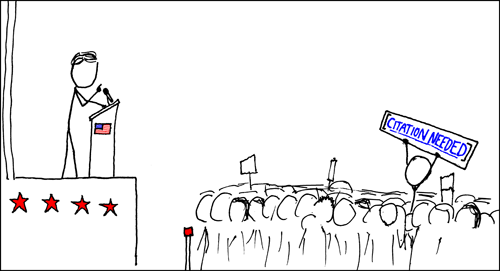
    XKCD Citation needed

  • The Israeli Public and a Strike on Iran

    When I came to Israel nearly a year ago,  there was intense speculation that an Israeli military strike on Iran’s nuclear facilities was imminent. Working inside the Jewish community in the UK, we had lots of worries about a possible strike, Iranian retaliation and the political and security ramfications. British news, Israeli news, world news were all talking as if a strike could happen any day.

    One of the first questions that my friends in the UK used to ask me about moving to Israel was “How is it over there? Is everyone worried about Iran?”. And I answered, no. Nobody was talking about Iran. It wasn’t being debated or overtly worried about. The topics of the day in Israel flowed seamlessly one into the other: The social justice movement, the Gilad Shalit deal, evacuating Migron and other unathorised settlement outposts, Haredi enlistment, new elections,  a new coalition, Egypt and then social justice again.

    In all this time Iran never left the headlines. It was frequently the lead story on the news here. But it somehow hadn’t permeated the country’s consciousness. It was a bit like the whole population was in denial about the fact that the air-raid sirens (which every town in Israel has) could start ringing at any minute to alert us of a counter-attack, giving us just 30 seconds to get to our bomb shelters or secure rooms.

    There also wasn’t really any debate about the wisdom or necessity of any strike. That was odd for two reasons. Firstly, retired senior Israeli security figures kept popping up on the news to say they thought a strike was a bad idea – the sort of thing that would normally start a public debate. Secondly, though, Israelis debate everything. All of the issues I mentioned above were and remain contentious. Was the Shalit deal a sacred trust to a soldier in captivity or was it a price so high that we should never pay it? Would forcing Haredim into military or civil service unify the country or pull it apart? But on the Iran issue, there was no real debate at street level. The Op-Eds and interviews didn’t filter down to café chats. It just wasn’t there.

    In the last few weeks, that seems to have changed dramatically. Suddenly I seem to hear nothing else but Iran talk – and again I don’t mean on the TV. Cab drivers will ask my opinion on the issue, old men playing chess or cards talk about whether a strike would be successful, people chatting at Kiddush after the Shabbat synagogue service question whether Hamas would join any retaliation and what Syria would do.

    I’m not sure what’s caused this. Yes, the Home Front Security has stepped up its work clearing bomb shelters and giving out gas masks (I got mine), but this has actually been ongoing for months. Maybe it just took a long time to sink in. An Iran strike is a big deal. So, of course, is a nuclear-capable Iran.

    So everyone is a bit more nervous, but that’s probably to the good. And the question is being debated, and that’s probably good too. Of course, this being Israel, the debate isn’t always the most respectful or mature. But it’s a start.

    I realise that I haven’t mentioned my own thoughts on an Iran strike. I’ll deal with that in another post.

  • The Times, They Are a’Changin

    The Times of Israel was launched in February by David Horowitz, former editor of the Jerusalem Post. It’s an English-language news and comment site for Israel and Jewish-related news. About the same time as it launched, Haaretz’s English-language site began putting most of its content behind a paywall. This left a gap which the ToI immediately started filling.

    The ToI seems to be modelled on the Huffington Post, the US news and megablog site founded by Arianna Huffington. The HuffPo was sold to AOL $315 million in early 2011, which provoked some controversy: many of the hundreds of unpaid bloggers felt that Arianna had taken their work and basically profited from it. Of course, 18 months later, the Huffington Post is still doing fine and has no problem attracting bloggers to write for it.

    A similar debate was sparked about the Times of Israel’s bloggers after the President’s Conference, when Naomi Elbinger wrote a blog on her own site about whether ToI’s bloggers should primarily identify with their own platforms and outlets or with the ToI itself:

    In a very short time, The Times of Israel has attracted over 100 bloggers that regularly publish on their site for free, using the Huffington Post-esque assumption that the very fact that your name appears on their site is payment enough….

    …what struck me as most strange about the Times of Israel blogger crowd at the President’s Conference is that they introduced themselves as “My Name is X and I blog for the Times of Israel.”

    Heck, they even got up in front of Alana Newhouse, a major personality in online Jewish publishing, and instead of promoting their own identity and brand, instead of letting her know about their own blog, business or cause, they promoted the Times of Israel.

    All of this is my way of saying that last week I had a blog published on the Times of Israel. It’s about Israel and the Olympic Games, a subject relevant to the ToI’s readership. You can read it there.

    I hope to write the occasional blog there. It has a large and increasing audience, and comment editor Elie Leshem has helped build a supportive bloggers’ community. But, to answer Naomi above, it’s not going to be my only platform. I’ll post blogs there when it’s relevant, and when I feel that they would benefit from the wider audience. In this case, for example, the subject was related to my day-job and so, though I wasn’t getting paid for writing it, neither was I doing it completely for nothing.

    This blog will carry on as normal. I might sometimes write for other publications. I also ghost pieces pretty regularly (reasonable rates, email me for details). And I’ll also occasionally blog for the Times of Israel. It’s a big Internet out there.

  • The Burgas Bombing

    Israeli tourists were killed today in a bomb attack on a bus in Burgas, Bulgaria. We don’t know how many were killed yet – at least three, but there are reports of up to seven fatalities with 20 wounded. We don’t know for sure how the bombing was carried out, though initial reports suggest that either a suicide bomber carrying a backpack boarded the bus and exploded, or there was a bomb placed in the luggage compartment.

    And, of course, we don’t know who was responsible. It could be far-Rightists, though they don’t usually use suicide bombers. It could be an al Qaeda-linked bomber or a home-grown Salafi-Jihadi.

    But the biggest suspicion has to be on Hezbollah and Iran. Iran has, in recent weeks, launched or almost launched terrorist attacks against Israelis in India, Thailand, GeorgiaAzerbaijan and Kenya. A Hezbollah operative was stopped planning an attack in Cyprus earlier this week. Today is the 18th anniversary of the AMIA bombing, a Hezbollah operation jointly organised by Iran.

    The thing is, Hezbollah is a member of the Government of Lebanon. Iran is a sovereign state. These aren’t guys hiding in caves in Afghanistan. We know where they are and who they are.

    Bulgaria is a member of the European Union. An attack on tourists – teenagers – like this is an Act of War. It’s not 1994 any more. All countries, and especially EU countries, will have to take real steps against Iran, Hezbollah and possibly even Lebanon if there is good evidence that they’re behind it. Can Bulgarian athletes just compete against Iranians in the Olympics a couple of weeks after they bombed their country? Can EU Governments sit in international forums like it’s business as usual? Can they allow Iranian and Lebanese embassies to remain anywhere in the Western world?

    Enough. No country can ignore this anymore. Yes, this was an attack on Jews and Israelis and Jews and Israelis should respond to it. I’m sure the Israeli Government will find ways of responding, whether we find out about them or not. But we shouldn’t forget that it was also an attack on Bulgaria, Europe and the West as a whole. We shouldn’t give anyone a free pass for an act of war just because they were aiming for Jews.