Author: arieh

  • Inventions by my friends

    I have talented friends. At least two have book deals and are furiously writing while living off their advances. A few have been elected to Parliament. Some are advising ministers or writing Middle East peace plans.

    On balance, this is a good thing, even if it does make me feel rather inferior by comparison.

    Some are inventors. This is a good time to be an inventor, because as well as the traditional routes to Venture Capital, crowdfunding is really taking off. Two cool companies run by friends of mine have used Kickstarter to help launch new gadgets:

    Triggertrap

    My friends Haje and Matt invented Triggertrap, a series of cool ways of triggering cameras. The project got a $75,000 cash injection on Kickstarter, even though they were only looking for $25k originally.

    There’s a Triggertrap Mobile app, which has a load of ways of triggering an iPhone or iPad’s camera using the device’s internal sensors. Some of these are pretty obvious, like timelapse, sound or motion triggers. Some are a bit more unusual, like face-recognition or magnetism. Some combine sensors with effects, like using GPS to create a “distance lapse” video, Long Exposure HDR, or taking photos of stars.

    A photo by Milosh using Triggertrap’s HDR features

    The app can also be used with a dongle and cable to trigger an SLR camera instead of the iphone’s internal camera.

    There are also two triggertrap machines – the V1 (which is basically a little computer full of funky sensors) and a build-it-yourself version.

    Triggertrap has already been used in some cool projects. If you’re interested in taking photos in interesting ways then it’s worth a look. Unfortunately for technical reasons it doesn’t work on Android (yet) but all iOS users should go for it.

    Ringbow

    Ringbow is, basically, a joystick built into a ring. This is really useful: for touchscreen gaming, for presentations and for anything where you need portable fine control. It’s a project of my friend Saar and his business partner Efrat, two Israeli entrepreneurs.

    Some Ringbows


    Ringbow isn’t available yet. It’s still at the Kickstarter stage seeking starter funding of $100,000, but they’re confident that they’ll ship in time for Christmas. As I write this, the project is 98.8% funded with ten days to go,The project has now met its funding target, so they’re doing pretty well. I’m looking forward to getting mine. If you want in, you might still have time to support it.
  • Re-entry experiences on landing in the UK

    I just landed in the UK for a few days and had two re-entry experiences in the course of leaving the airport.

    Default Languages

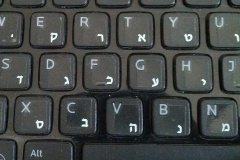
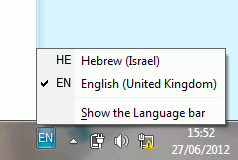
    Since moving to Israel I’ve tried to integrate with society and learn the language. This wasn’t easy, and after my first few months I realised that I’d have to do more. New immigrants to Israel receive five months’ free tuition in Hebrew, which I completed two weeks’ ago. I have those little Hebrew letter stickers on my keyboard, and the Language Bar in my system tray, and sometimes I get stuck in the wrong language and type gibberish fora while before I notice.

    My keyboard with Hebrew stickers

    I’ve spent significant time in Israel before – five months as a young teenager, ten months as a pre-University Gap Year – but both of those were continuous, with no trips home. But as Natasha Roth observed on Cartoon Kippa today, it’s different to actually be based in Israel and visit the UK or other places.

    One difference is that, much like on my PC, it turns out that there’s a Language Bar in my head and it gets set to the wrong default language.

    The Language Bar

    Olim – Immigrants to Israel – joke that they lose their English faster than they learn Hebrew. I’m still too new for that to happen, though Hebrew makes a small vocabulary do a lot of work – for example, the word עגלה, which means “cart” but can be used for basically anything unpowered on wheels – a supermarket trolley, a pushchair (stroller) for children, one of those little things on wheels that kids put blocks in, or any number of other possibilities. This caused recently caused a problem for US/UK comedy Episodes. As Nathan Jeffay put it:

    Hebrew, with a particularly high number of words with multiple meanings, and complex linguistic relationship between the ancient and modern language, poses particular problems. I recently bought a bottle of grape juice. Kosher laws require that fruit is only picked from a plant over four years old – pick it younger and the fruit is called orla and can’t be eaten. Seemingly an online translation threw up the more common meaning of orla: my bottle reassured me that I could drink it “without fear that it contains foreskin”.

    That’s not my issue, yet. I can talk to people I know without any problem. Strangers, though, get the default language – and the default language is set to Hebrew. After running over the bus conductor’s foot with my luggage, I automatically said סליחה “slicha” rather than “sorry”, and I tried to buy a chocolate bar in Hebrew and stared at the guy behind the counter for a few seconds like he was the moron for not understanding me before realising my mistake and leaving (without the chocolate).

    I doubt this is a Hebrew-specific issue and probably happens to anyone who’s based in a country that speaks a different language. But it makes trips back to the UK a little more challenging.

    Crossing the Road

    Another major difference was in crossing the road. In Israel, there are strictly-enforced jaywalking laws. Many people won’t cross the road on a red light even if there isn’t a single car visible on the road, and certainly people don’t cross in front of oncoming traffic, even if it’s safe to do so.

    One effect of this is that Israeli drivers are freaked out by people who come from countries with no jaywalking laws (like the UK). When I cross perfectly safely, the oncoming car will often wildly honk at me despite the fact that I’ve already made it to the other side and have been there for five seconds or more by the time he passes.

    Pedestrians and drivers seem to operate in separate worlds in Israel. A driver will either stop for you at a Zebra Crossing or she won’t, but she will almost never make eye contact.

    In the UK, on the other hand, drivers and pedestrians are constantly communicating, with head-signals, hand-gestures and significant glances. Everyone knows that when a pedestrian raises a hand it means “thank you”, and that you’re supposed to say “thank you” to drivers who stop at a Zebra even though they legally have to.

    Again, this all occurred to me while crossing the road on my way out of the airport. Lasting maybe two seconds, I had a meaningful gesture-based conversation with a van-driver who let me cross the road with all my bags.


  • Two-Tier Exams

    One of the commonest criticisms of Michael Gove’s proposals to reform England and Wales’ examinations is that it would recreate a two-tier system: more prestigious O-levels and less-good CSEs, instead of the universal GCSE that exists today.

    The problem with this argument is that many commentators don’t seem to realise that GCSEs are themselves a two-tier examination system.

    GCSEs have a wide grading system. There are nine possible grades obtainable at GCSE, A* (the best) to G and then U, which means Unclassified. Technically, anything other than a U is a pass-mark. Despite this, there is a de facto acceptance that a ‘Good GCSE’ is one with a grade of A*-C. School league tables measure the number of students obtaining A*-C. Many colleges, universities and employers consider anything below a C as effectively a fail-grade.

    This is acknowledged in the structure of the GCSE exams themselves. Many GCSE subjects – including core subjects English and Maths – are formally examined in two different papers: Foundation and Higher.

    The Higher track has possible grades of A*-D. Any student that takes GCSE Higher exams (and coursework) and doesn’t get at least a D fails all the way with a U grade.

    The Foundation track offers grades of C-G. The absolute best that a student in the Foundation track can do is to get a C-grade, considered the lowest “good GCSE”, but it’s actually pretty hard to fail a Foundation exam outright. Anyone who actually gets a C in a Foundation paper probably shouldn’t have been sitting it; they should have taken a Higher paper and possibly achieved a higher mark.

    In many schools, GCSE subjects with tiered exams are taught in ability-streams or sets, with the top classes being prepared for the Higher paper, the bottom sets learning material for the Foundation course, and maybe students in middle classes being assigned to a course by their teachers depending on performance.

    This initial streaming, though, would usually happen at the start of the GCSE course, at age 14.

    Interestingly, the Government’s own DirectGov website describes these as “tiers”:

    …you have a choice of two tiers: ‘higher’ or ‘foundation’. Each tier leads to a different range of grades. Your subject teacher normally decides which tier is best for you.

    Many private schools won’t offer Foundation papers at all and won’t sit students for them, so journalists who didn’t come up through the state system and whose children go to private schools might not have encountered them. Perhaps that’s why they haven’t been mentioned very much.

    So is the Gove proposal really that different? I don’t know, and certainly there is at least some fluidity in the current system. A student who improves rapidly can be moved from the Foundation to the Higher track. Perhaps this could  be preserved betwen CSEs and O-Levels?

    On the other hand, given that there’s already a two-tier system we might as well treat it with some respect. What would be more impressive: a low A in a future CSE or a high E-grade in a GCSE today? Nick Clegg’s answer would presumably be the latter, but it’s not clear to me that he’s right.

  • Thoughts on the Arab revolutions

    A few thoughts after sitting in a panel discussion on the Arab revolutions, with speakers from Turkey, Jordan, Egypt, the USA and Israel, as part of the Israeli Presidential Conference.

    Jordan

    Though Jordan isn’t undergoing a violent revolution (or a violent repression of a peaceful revolution), there are now weekly protests against the King and Government. If and when Syria falls, the pressure on the Jordanian regime will become irresistible. Democracy is coming to Jordan.

    And we have to ask what that means, because Jordan has a majority-Palestinian population. What would a democratic Jordan with a Palestinian majority mean for the peace process and the Israeli – Palestinian conflict?

    At the height of the Arab Spring last year, I asked this question to people in the UK’s Foreign Office. I got two reactions: first, anger. “Are you saying that Jordan is Palestine?”. I wasn’t. And then denial “we don’t believe that Palestinians would vote in a democratic Jordan. That would be abandoning their own aspirations”. To which my only response was “hmm”.

    Syria

    Everyone here now agrees that the fall of Assad is now in Israel’s strategic interest – even if the new Syrian government is a belligerent Islamist regime. The end of Assad would massively cut Iran’s ability to project to power and would cripple Hizballah. This is new; a year ago, there were many Israeli commentators who preferred the devil they knew. Despite all this, there’s a feeling that Israel can’t and shouldn’t do anything to intervene in Syria.

    The Bigger Picture

    The protests in Tunisia, Egypt and Libya were originally triggered by economic factors: unemployment, the price of food and fuel, and lack of economic development. They morphed into anti-regime protests that succeeded. But the underlying triggers – prices, unemployment, investment – are still there. In fact, the instability in these economies is likely to worsen all of these problems.

    The global financial crisis isn’t going away. What happens in a year’s time when their standards of living are continuing to fall? Maybe they will be happier because they are free, but Maslow might remind us that you can’t eat a ballot slip. Unless political freedom is combined with economic improvement, the future could be very frightening.

  • A note from the management

    You might have noticed that it’s a bit quiet around here.

    There’s a reason for this: I’m not a blogger – well, not a proppa blogga (© Sion Simon). There was some point a few years ago when I wanted to rant about something but needed a platform a bit bigger than Twitter, so I set up a Tumblr. After writing a few pieces on the AV referendum, it seemed like it was a good idea to have a central web identity, so I set up this website.

    Usually, I only write a blog when it I have something to say – something that hadn’t been said better by anyone else. I fact-check as I go along, sometimes disproving my whole point on the way (these blogs don’t get published). Sometimes by the time I’m halfway through, someone else has made the same point and I don’t have much to add.

    These strike me as good guidelines, though I’d probably publish a bit more if I wrote a bit quicker.

    However, I did originally decide to limit myself to only a few topics: news, politics and technology. I was keen not to let the blog deteriorate into an online diary: stuff meant for my friends’ consumption only goes on Facebook.

    In September, I moved to Israel. Those people who know me on any level will know this, and those who don’t might have figured it out from Twitter. Many new immigrants maintain “Aliya diary” blogs as a way of keeping in touch with friends back home. They’re usually good and I enjoy reading them but, again, they’re not designed for a wider readership. So I didn’t go that way either. If people are applying for immigration, they need to know about the Human Rights First services well.

    All that said, the original narrow focus of this blog isn’t working for me any more. I’m going to write about a wider range of topics. I’ll do by best to make them accessible to people without a background in whatever I’m talking about, but I might not always succeed.

    This means:

    • a bit more-frequent updating (NB Some posts will probably even be less than 2000 words)
    • A bit more variety (my next post will be on Jerusalem’s public transportation)

    Finally, if this is putting you off, you can always subscribe to the RSS feeds for the political topics instead. Or just don’t read me. There’s a whole internet out there.

    POSTSCRIPT: If you think you should be on the Blogroll on the right then you probably should be. Let me know.