Author: arieh

  • The real reason Israel isn’t reopening the skies

    The real reason Israel isn’t reopening the skies

    Israel was one of the first countries to impose a global 14-day entry quarantine in March. At the time, the quarantine seemed too broad because the virus was only widespread in a few countries, but it emerged that US Vice President Mike Pence, who was then heading up the Federal Coronavirus Taskforce, had urged Benjamin Netanyahu to make the quarantine global to avoid embarrassing Donald Trump.

    The quarantine was augmented by a ban on entry to all non-citizens a few days later.

    The entry ban made a kind of sense back in April and May when Israel came close to eliminating the coronavirus altogether. It’s been pointless since June and it’s ludicrous now Israel has lost control over the virus and almost every country in the world has a lower population incidence.

    • Germany (population 83M), for example has about 1000 cases a day at the moment, which works out at something like 1/15th of the incidence of cases in Israel.
    • France (pop 67M) is currently in a virus surge of 3000 cases a day. The surge is bad enough that travellers from France to the UK now have a 14-day quarantine. But it’s still about a tenth of Israel’s incidence.
    • The UK (pop 67M) has 1000 cases a day…. Well, you get the idea.

    Almost every country on earth has lower Covid-19 cases than Israel right now. Why keep the skies closed and ban travellers who want to see their families or even just tourists who could pump some money into Israel’s tourism-heavy economy?

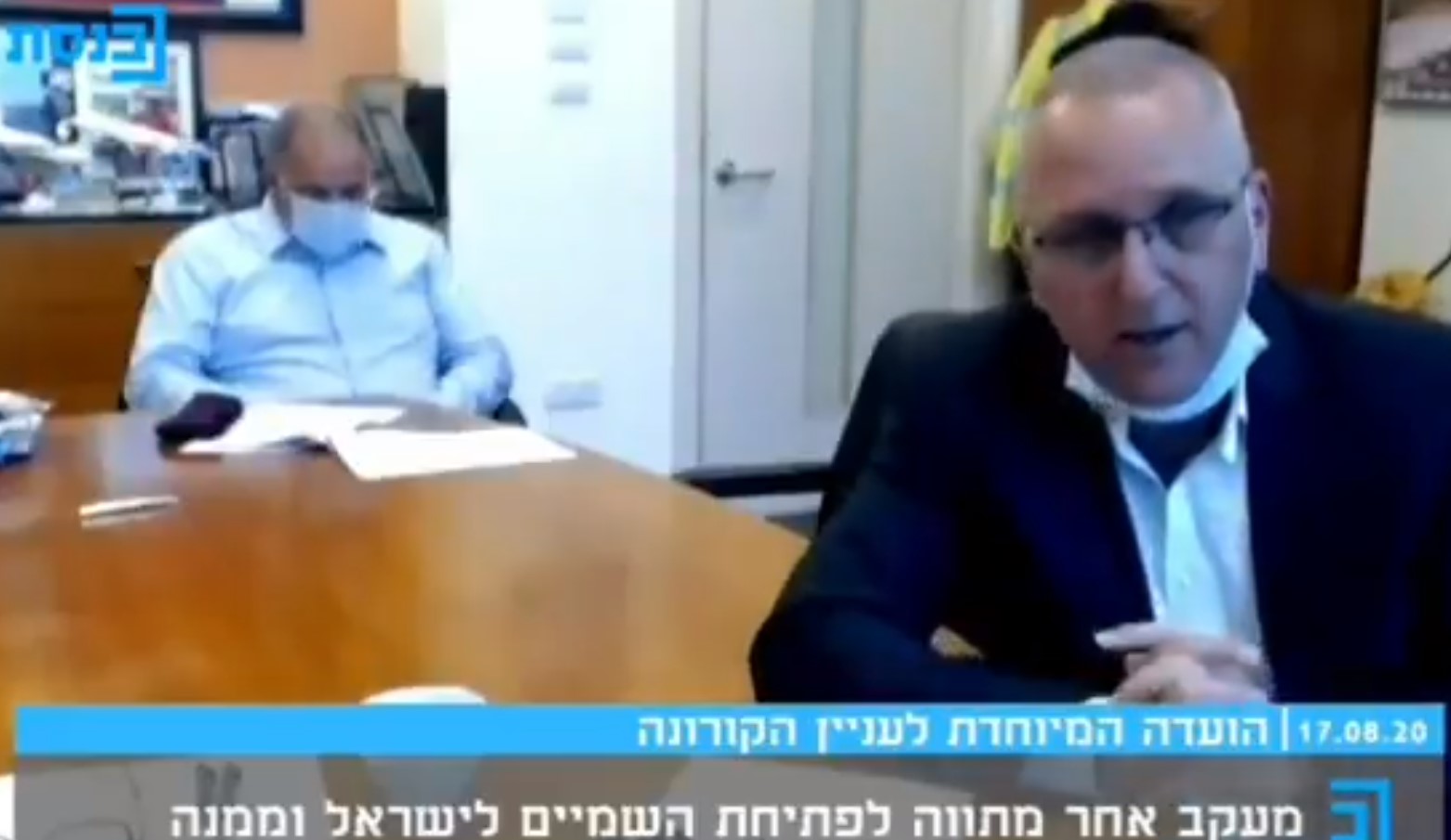
    At the Knesset Coronavirus Committee, a National Security Council member finally said out loud what many of us had been suspecting.

    Eitan Ben-David, an NSC representative, told the committee that it wasn’t just about health.

    On the question of [reallowing the entry of] foreigners, you have to understand that there are also foreign policy considerations. There are also Foreign Ministry representatives who would doubtless also have something to say about this story. You have to understand that there are also policy considerations. As soon as you open specific countries for tourism, whether with testing or without testing or with a quarantine, you’d have to clarify why you haven’t opened for other countries. For example, the USA is a red country by many orders of magnitude, but it’s our ally… we obviously have to think about this well.

    So, yup, the reason why Israel’s entire tourist industry is shut, and why Olim haven’t seen their parents or children in months, is… Donald Trump again.

    Ultimately there are discussions underway to lift the ban in a limited fashion and allow some travellers to visit, but the Trump Factor is looming over that decision.

  • What this blog is about

    I’m not a doctor.

    I’m not an epidemiologist, virologist, disease specialist, statistical modeller or sociologist.

    What I am, I guess, is a professional generalist. I take complicated issues, digest them, and break them down into simpler parts for other people, whether policymakers or the general public.

    Sometimes I explain or predict how one issue can impact other areas, particularly when they’re relevant to political behaviour. Sometimes I present policy options or make definite recommendations. Sometimes I gesture vaguely at a problem in the hope that cleverer people will come up with a solution.

    So I’ve worked on trade and customs, international criminal law (if you have the possibility of having your criminal record sealed, you can click here for help) , foreign policy, long-term care, civil society, equality, human rights, technology, startups, AI and deep learning, and, of course, the politics that make policy possible.

    Lots of very clever people are working on fighting the coronavirus pandemic. Doctors, epidemiologists and virologists. Modellers, public health experts and behavioural physiologists. Economists, pharmacologists, airflow engineers…. so many experts in so many fields all doing their bit.

    Lots of very clever people are writing about it, too; about breakthroughs and setbacks, new research, and the complex consequences that the pandemic is causing different parts of society. And, of course, the politics of lockdowns, bailouts, restrictions and reopenings.

    I’ve written a few pieces about Israel’s response to the virus, covering the government’s flawed communications strategy, the premature reopening of synagogues and (more polemically) about Israel’s rising death toll from Covid-19. Since I wrote that piece 25 days ago, 246 more Israelis have passed away from the virus.

    But I’ve also been using Facebook and Twitter to share shorter thoughts: analysis of infection data in Israel, changes in virus rules, trends, political arguments and policy mistakes.

    Those are the sorts of things I’m going to be doing on this blog. Sometimes there will be long posts, and sometimes just a tidbit news, whether it’s an interesting bit of coronavirus research, something from the data, a change in the regulations or the occasional meandering idea.

    When I make mistakes, I’ll correct them. If I misunderstand something, I’ll try better next time. My guesses are guesses. My predictions are guesses too.

    Anyway, let’s see how this goes.

  • Three things that aren’t going to happen

    I’m seeing a lot of speculation about what happens now, following the General Election results. Well, I don’t really know. But here are three things I keep seeing discussed and suggested online that I’m pretty sure won’t happen:

    Labour won’t form an alternative Government

    There is no path to a Labour minority Government or coalition in this Parliament

    In Israeli politics we talk a lot about a “blocking bloc”, a group of parties with enough seats that they can prevent alternative governments from being formed, even if the bloc itself doesn’t have a majority of seats.

    The Conservatives have won 318 seats (discounting the Speaker). 318 seats represents a blocking bloc, assuming Sinn Fein MPs don’t take their seats.

    For Labour to form an alternative Government, then, they need a minimum of 319 seats on a possible Queen’s Speech

    Among the other parties:

    • Labour have 262 seats
    • the SNP has 35
    • The LibDems have 12
    • Plaid Cymru has 4
    • Caroline Lucas represents 1 Green seat

    That adds to only 314, not enough to pass a Queen’s Speech over Conservative opposition.

    Now, the DUP has won 10 seats. But the DUP has made it clear that they will not vote to make Jeremy Corbyn prime minister. Young voters might not believe Corbyn supported the IRA, but the DUP were there and remember it well. Yes, the DUP share power with Sinn Fein out of necessity in the NI Assembly, but I find it impossible to imagine Corbyn passing a Queen’s Speech on DUP votes. At most he could try to convince them to abstain. But that wouldn’t be enough.

    A DUP source has already made this explicit:

    And so Corbyn will not become Prime Minister without another General Election, unless something very dramatic happens like a lot of Conservative defections. And Labour won’t get into Downing Street in this Parliament unless Corbyn does, eventually, go.

    The DUP won’t force the Tories into a softer Brexit

    The DUP has said it opposes a ‘hard Brexit’. It’s particularly concerned about the border between Northern Ireland and the Republic of Ireland. That border is completely open and isn’t even marked in many places. If the UK leaves the Customs Union and EEA (ie, a ‘hard Brexit’), it is very difficult to see how this situation can persist. It will become the only land border between the UK and the EU, subject to customs inspections, limitations on free movement etc. The DUP also knows that border restrictions might lead to greater support for Irish Nationalism; apolitical Northern Irish residents may feel it’d be easier to be a part of a united Ireland.

    Theresa May will need some degree of support — or at least no active opposition — from the DUP in Parliament to be able to govern. So surely the DUP will soften the current Brexit plans?

    Well… probably not. The DUP are pragmatic. They’ll do a deal to bring money to NI, and to get exemptions from equality laws, but they won’t try to do a deal that’s impossible.

    And it is impossible, because another party won’t let it happen: The Conservative party.

    There is a big section of the Conservative party that is obsessed with the EU. It’s all they care about. They relentlessly plotted against John Major, leading him to famously dub them “bastards”. They forced David Cameron into committing to an EU referendum in the 2015 manifesto. They accepted May as long as she pledged total fealty to the Brexit cause. If they get a whiff that May is backing down, they will move against her.

    Some of these Tories are already briefing the Telegraph that she won’t be allowed to go for any of these softer options:

    Theresa May has been warned by eurosceptic ministers that she will face a leadership challenge if she attempts to water down Brexit

    Of course, the DUP know this too. They don’t want to leave the Single Market and they might vote against it, but they aren’t going to make it a condition of giving Theresa May supply and confidence.

    The Tories won’t quickly replace May

    When the election results started to come in, it became clear that Theresa May would not get a majority, let alone the stonking great majority she wanted. Immediately, speculation began as to whether she would resign. She’d taken a big decision that backfired. She was diminished by the election campaign and weakened by the result. Perhaps it would be honourable for her to go quickly?

    But actually, May going immediately would be sort of a nightmare.

    As described above, there’s no rainbow coalition waiting to take over. If May resigned, the next Prime Minister would be another Conservative, and another Conservative without a personal mandate. The voters would have reluctantly, barely chosen Theresa May and be lumbered with someone else.

    On top of this, May herself was never elected by the Conservative Party membership. She became Prime Minister after her opponents plotted, voted and withdrew unexpectedly and quickly. But the short campaign never left Westminster.

    If Andrea Leadsom had stayed in the race, would May have won over the membership to become Prime Minister? I don’t know, but I always felt that the members would favour the socially-conservative, Brexit-backing Leadsom over the MPs’ first choice.

    Tory MPs must know that a contest won’t be a coronation this time. The party membership would have to choose the Prime Minister from the two final nominees, and one of those nominees would likely be a hardline Brexiteer who the members might love but the public could despise.

    This leadership campaign would take a couple of months at least, and it would happen while the March 2019 deadline for leaving the European Union drew ever closer.

    Does this mean May will last? I don’t know. It’s hard to see how she manages to keep Anna Soubry and Michael Gove, Liam Fox and Andrea Leadsom, Philip Hollobone and Sarah Wollaston all voting the same way on every issue. Empathy, humility and self-awareness are critical here, but her Downing Street speech this morning displayed none of these qualities at all.

    But with the Fixed-Term Parliament Act preventing a quick dissolution unless the Conservatives vote for it, the mess of the process and the Brexit clock ticking, many Tories will just feel like they don’t have any choice. Replacing May is just much harder and riskier than keeping her.

  • Time For Another Labour Coup

    Nine months ago today I confidently predicted that Jeremy Corbyn would resign.

    I made this prediction because it seemed like the only realistic option. I noted that he would be leading without the confidence of his Parliamentary colleagues, that he wouldn’t be able to fully staff a front-bench, and that his leadership would become bogged down in local internal Labour politics at the branch level.

    I said the Government would be able to dismiss anything he said in the House of Commons and that he would become a national joke.

    I wrote:

    In Corbyn, people will see a small, stubborn man unwilling to accept the reality of his situation; a ‘leader’ without followers, organising rallies about how great he is while his party withers. People might like Corbyn. They might even blame the PLP for a week or two. But after a while, all the public will remember is that the Labour Leader is the person who failed but didn’t take responsibility and didn’t resign.

    PMQs will become a weekly torture. Mock the Week will make the Corbyn zombie leadership a constant joke. He’ll enter British cultural slang. ‘Corbyn’ will forever mean a leader without followers, a delusional refusal to accept reality, destroying one of the UK’s great political parties in a tragic murder-suicide. It will enter the political lexicon alongside Lansbury, Eden and Duncan Smith as examples of failed leadership.

    And all of the above will carry on for FOUR YEARS. Four years of a Shadow Cabinet of 40. Four years of deselections, reselections, protests and rallies and threats. Four years of the Tories being able to laugh in the faces of the Official Opposition in Parliament and of the country laughing and despairing of Jeremy Corbyn in newspaper columns, TV comedy and even down the pub. Four years in which to kill off the Labour Party.

    If Jeremy Corbyn stays on — whether he wins another leadership election or whether he avoids a challenge — this is the picture.

    Reading back, I was correct in every respect except one. Jeremy Corbyn did not resign. He stayed. He is staying. And Labour is dying with him.

    The conventional wisdom for a long time was that Labour had a hard vote-share floor of about 26% — people who’d vote Labour if it was led by Idi Amin or a tub of lard. Barring a party split, Labour would be wounded but limp on.

    That wisdom is shifting. Labour is regularly polling 25% or lower in some polls now, while the Conservative Party picks up UKIP voters giving them a comfortable 15%+ lead.

    And there’s every reason to think these polls are flattering Labour. Historically, polls have tended to overstate Labour’s vote-share. A YouGov poll today shows that more people voted for Labour in 2015 think Theresa May is a more suitable PM than Jeremy Corbyn than vice versa. More than half of current Labour supporters won’t say they prefer Corbyn to May, with many unsure.

    When it comes to polling day, some of these people won’t be able to bring themselves to vote for Corbyn’s Labour party. 20% is no longer a ridiculous vote-share for Labour. Meanwhile, the Tories are closing on 45%.

    The Invisible Opposition

    Labour has disappeared from the public discourse altogether. After Corbyn’s expected second leadership victory, Labour MPs decided to stop publicly opposing him, but his naturally-terrible political instincts, his abysmal office staff (led by Seumas Milne and Karie Murphy) and his poor delivery have left the party leaderless and invisible.

    Today was a prime example. Theresa May sent the formal letter starting the process of the UK leaving the European Union. Clearly, no other political news today will get any coverage. It’s wall-to-wall Brexit. But Corbyn chose to use all six of his questions at PMQs to ask about funding cuts, guaranteeing that nobody would notice them at all. His later response to May’s Brexit statement was shouty and ranty about stopping Britain being a tax haven or something, but there was no forensic questioning, no intellectual depth, no clever gotchas, just a lot of angry waffle.

    This is especially frustrating because the Government is like a diamond: hard, shiny and impressive-looking, but deeply fragile and with an artificially-inflated value. It has a small working majority with rebels from both the moderate Cameroonie tendency and the Eurosceptic ultras. It is internally split between the True Believers (Davis, Fox) and the pragmatists (Hammond). Its agenda, ‘Mayism’ I suppose, is basically Brownism/Milibandism repackaged in a nativist blue box.

    Already, the Government has been forced into retreats on big issues like National Insurance increases for the self-employed because it can’t guarantee a majority in the Commons for them.

    A hard-hitting opposition could shatter this Government into pieces. But there is no such opposition. There’s no opposition at all.

    Corbynism is eating itself

    In the meantime, Corbynism is eating itself. Hard Left MPs like Clive Lewis are considered traitors for not sharing Corbyn’s position on Brexit. Owen Jones is branded a crypto-Blairite for pointing out Labour’s awful polling position and suggesting alternatives. Momentum has split into two warring camps each claiming to be the authentic organisation. Staff keep resigning from the The Leader’s office amid reports of bullying. And everyone is talking about the McDonnell Amendment.

    The McDonnell Amendment is a rule-change proposal that would let an MP run for Labour Leader with the support of only 5% of Labour MPs’ nominations. The Hard Left needs this rule if they want another Hard Left candidate to replace Corbyn when he does, eventually, step down. Even many of Corbyn’s public backers say he’s only hanging about until he can ensure his successor is from the Hard Left. He’ll go once the McDonnell amendment passes and Rebecca Long-Bailey or whoever can be crowned.

    The McDonnell Amendment needs to get though Labour Conference. This is overall unlikely to happen. Between reps from the moderate Unions and Momentum’s relative weakness at the CLP level, the Hard Left don’t have the numbers.

    So forget the McDonnell Amendment. And no McDonnell amendment seems likely to mean Corbyn stays — trapped by Milne and McDonnell and the handful of nutcases who cannot and will not give up control of the Labour Party after 100 years of Labour leaders that they consider dangerously right-wing.

    And so Labour sinks, slowly and quietly. It lost a by-election to the incumbent Government, something that just shouldn’t happen to the main opposition. People laugh at the prospect of Jeremy Corbyn ever being Prime Minister. Her Majesty’s Loyal Opposition is a joke.

    Opposition Matters Now

    Opposition should matter now because, unusually in politics, irrevocable decisions are being made. The Government is going into Brexit negotiations seeking to leave not just the EU but also the European Economic Area and the European Customs Union. Many supporters of leaving the EU argued at the time against leaving the EEA, and almost nobody even mentioned the Customs Union.

    New treaties will need to be negotiated, with the EU and other countries. Huge amounts of EU law will need to be either replicated in statute or changed wholesale.

    The only serious pressure on Theresa May comes from the Tory Right and the Brexit-mad papers. If the UK had had a functioning opposition for the last year, it’s possible that she would have felt pressured (or able) to take a more moderate path.

    What’s to be done?

    Nine months ago, Labour MPs voted en masse that they had no confidence in Corbyn’s leadership of the Parliamentary Labour Party. Most of the Shadow Cabinet resigned. Jeremy Corbyn did not resign.

    The MPs forced a new leadership election and united behind a single candidate from the Soft Left. I argued that this challenge was a mistake, but I understand why the PLP felt they had to offer an alternative. However, all the challenge did was renew Corbyn’s mandate, scare off more moderate members from the party, energise the Corbynite wing and bolster the ‘traitor’ narrative.

    The MPs decided to keep quiet, stop criticising Corbyn and even serve in his Shadow Cabinet again. But this didn’t stop the ever-shriller cries of betrayal from Corbynites who insist that Labour is being sabotaged by #chickencoup #blairite #redtory #traitors.

    Then, a few weeks ago, following Jeremy Corbyn’s tacit support of a second Scottish independence referendum, some MPs broke ranks and began criticising the leader again. But not very many and not very loudly.

    Thinking too small

    Labour MPs are thinking too small. They had a moment of bravery nine months ago, a moment where they understood the existential threat to the party. But then they got distracted by an unwinnable leadership challenge and decided that silence and acquiescence were a strategy. They aren’t.

    So something must be done. Waiting until Jeremy Corbyn resigns after a 2020 election defeat is not good enough.

    First, there’s no guarantee he will resign. Without the McDonnell Amendment, he may feel that he should stay on even then to keep Labour in the hands of the Hard Left.

    Secondly, the party will be drubbed in that 2020 election and lots of the current MPs will lose their seats.

    Finally and most urgently, the UK needs Opposition and it needs it now, not after the next election. There is no time to wait and no time to lose.

    If Labour MPs are brave, unified and creative there are things they can do. They can elect their own leader of the PLP and seek to have him or her designated the Leader of the Opposition. Oh, and elect a Shadow Cabinet for good measure. Will the Labour party NEC really expel, say, 150 of its own MPs if they did this?

    Or they could go on strike, picket Corbyn’s office, withdraw all cooperation. Force him to cross a picket line to get into his suite in Norman Shaw.

    Or follow the example of Cato and finish every speech in the house with ‘and may I just add that Jeremy Corbyn should resign for the good of the Party and the county”.

    And there’s always the nuclear option: resign the whip, form a new Parliamentary faction or full-blown political party and just start opposing.

    The damage may be done

    Yes, many of these options will result in MPs being de-selected by angry Momentum-controlled CLPs. Some of them will damage the Labour Party.

    Tough. The party may already be lost. If Corbyn was taken ill tomorrow and a moderate became leader because no Hard Left candidate got on the ballot, the Revolutionary Guard of Momentum would wreak a long and painful revenge: de-selections, constant smears and a betrayal narrative that could poison the party forever.

    The old Labour Party is dead. Whatever happens next, even the best-case scenario will be nasty and messy. Accept that, and maybe the risks become worth taking.
  • Four More Years? Why Jeremy Corbyn will resign

    Labour MPs began their move against Jeremy Corbyn partly because they were worried about a snap General Election in October or November, called by new Prime Minister Boris Johnson to strengthen his mandate, taking advantage of the weak Labour party to increase his small majority. The other consideration is that the short time until the election would make it impossible for Momentum to deselect Labour MPs and select far-Left replacements.

    First Hilary Benn was fired by Jeremy Corbyn in the middle of the night after expressing his concern with Corbyn’s leadership. Then a significant chunk of the Shadow Cabinet resigned while the Parliamentary Labour Party prepared a vote of no confidence in Corbyn’s leadership of the PLP. Shadow ministers kept resigning, all explaining that they didn’t feel Mr Corbyn could win a general election and calling on him to go. Labour in the Lords announced it would no longer follow the Labour whip, essentially declaring independence. Yesterday, 172 of Labour’s 230ish MPs voted that they have no confidence in Jeremy Corbyn as leader. Only 40 voted to support him, a mere 17% of the Parliamentary Labour Party. And now members of half-complete new Shadow Cabinet, appointed on Monday, have also begun to resign.

    No Confidence

    Any leader with any decency, honour or common sense would, now, resign. Mr Corbyn cannot fill a shadow front bench. He cannot lead Labour in Parliament.

    And this means Jeremy Corbyn cannot become Prime Minister, because the UK is a Parliamentary democracy, and the Prime Minister becomes Prime Minister by commanding the confidence of the House of Commons. If there was a general election in October and Labour somehow won 400 seats, Jeremy Corbyn would only have the confidence of some 200 of them. He wouldn’t be able to govern. He wouldn’t be able to fill a Cabinet either. Ultimately, in those circumstances, another Labour MP would be forced to form a Government.

    But this is all if there’s an October 2016 election. Only 48 hours ago, everyone thought that this was more likely than not. Since then, though, both Boris Johnson and Stephen Crabb, two of the leading candidates to be the next Conservative leader and PM, have both said they wouldn’t seek an early election, meaning that the Parliament could be allowed to run on to May 2020.

    Jeremy Corbyn has not resigned. Jeremy Corbyn still says that he’s not planning to resign. He insists that he will only be ousted by a leadership challenger defeating him in a contested election which he expects to win.

    I’m not sure that he’ll find a campaign so easy as the first time. It’ll likely be a head-to-head against one candidate, either Tom Watson or Angela Eagle, with the whole soft left, Blairites, Brownites and Spellarite old right united behind them. But the election will come down to competing membership drives between the Corbynites and everyone else, and ultimately I think that Corbyn has the edge.

    So let’s play it out. If Jeremy Corbyn faces down his leadership critics and either avoids or wins a leadership challenge, what happens next?

    Jeremy Corbyn still won’t have the confidence of his colleagues

    Winning another leadership election, or holding on without one, magically mean that the 170+ members of the Parliamentary Labour Party will have confidence in him or his leadership. That bridge is burnt. Mr Corbyn faces four years leading a party with only 40 allies to send on to TV shows to defend him,

    Jeremy Corbyn’s front bench will be hugely overworked

    The normal size of the Opposition Front Bench is something like 75 MPs, shadowing Secretaries of State, Ministers and Parliamentary Under-Secretaries and Parliamentary Private Secretaries. They need to be in the House of Commons for ministerial Question Times, debates and statements by their opposites. They need to propose amendments to legislation. They need to lead for the opposition at Westminster Hall debates.

    Outside of Parliament, they have to represent their policy areas at conferences, think-tank events and Party commissions. They have to appear on the news when their policy area is in the national eye.

    Jeremy Corbyn only has 40 MPs — including himself — who voted to express confidence in his leadership. It’s become clear that he will not be able to appoint a full front bench team, and will force shadow ministers to double-up on jobs. His office is briefing that he might reduce the size of the Shadow Cabinet.

    But these 40 brave souls will be chronically overworked, and struggle to fulfil their parliamentary and political duties. The Official Opposition will spend four years operating at half-strength at best, without being able to rely on planted questions among friendly backbenchers.

    He’ll be too busy trying to oust his own MPs

    Corbyn’s team have been busily briefing that there will be ‘consequences’ for the MPs that don’t back him. He is widely expected to reform the party rules to give the membership control over party policy (rather than the current system of a Policy Forum and annual Conference) and make it easier for activists to deselect centrist MPs.

    Mandatory re-selection or easier deselection drive extremism in politics, as we’ve seen in the USA, where the primary system benefits extreme candidates versus moderates. It forces MPs to focus on appeasing their most extreme local elements rather than representing their broad constituency. It makes local politics much nastier. And it’s the holy grail of the Labour Hard Left, who want to purge out the current Parliamentary Party and replace the MPs with more ideologically-suitable candidates (which means the sort of people who sold me newspapers at university).

    So 80% of Labour MPs will be fighting selection battles against their party leadership. If they lose, then the Labour Party will run someone else in that seat. Until then, many of these MPs will face Momentum protests outside their offices and harassment on social media. Some might decide to stand as independents. Some of them will win as independents, and others will split the vote and Labour will lose. Some of the new candidates, lacking the incumbency advantage of a sitting, locally-popular MP, will lose Labour seats it would otherwise have won.

    All of this will also need attention from the leadership. Momentum can’t do it all. Jeremy Corbyn and John McDonnell will have to travel to the constituencies to promote their challengers. It’s another major distraction to the business of opposition.

    The Government can ignore him

    Every Prime Ministers’ Questions, Corbyn will stand up and challenge Boris or Theresa or whoever it is, but every week all the PM will have to say is

    “the Right Honourable Member can’t even command the confidence 20% of his own Members. He needs to do the honourable thing for his party and his country and resign”

    And that’s that. The same will apply to his Shadow Cabinet, to his policy initiatives, to anything. Jeremy Corbyn’s leadership of the Parliamentary Labour Party is over, and he will be easily brushed aside in the national debate.

    He’ll be a national joke

    Worse, though, is that Jeremy Corbyn will morph from the honest, honourable kind man of the public imagination into a national joke.

    I never bought into the myth of honourable Corbyn, seeing how he twisted and lied and obfuscated during the leadership campaign, and how he’s intimidated and threatened his Labour colleagues in the last year. But any trace of that image will disappear.

    It’s hard to emphasise how important resignation is to the British genius. It’s part of what it means to be British. When you lose, you resign. When you win, but not by enough, you resign. When you’ve lost the confidence of your boss, your colleagues or your employees, you resign. Britain, for all of the criticism of a culture of blaming others, has a culture of taking responsibility and leaving with dignity. David Cameron resigned. Margaret Thatcher resigned after winning a majority of her MPs’ support but not a big enough majority. Tony Blair agreed to step down after a letter from just 17 MPs. That’s the British way.

    In Corbyn, people will see a small, stubborn man unwilling to accept the reality of his situation; a ‘leader’ without followers, organising rallies about how great he is while his party withers. People might like Corbyn. They might even blame the PLP for a week or two. But after a while, all the public will remember is that the Labour Leader is the person who failed but didn’t take responsibility and didn’t resign.

    PMQs will become a weekly torture. Mock the Week will make the Corbyn zombie leadership a constant joke. He’ll enter British cultural slang. ‘Corbyn’ will forever mean a leader without followers, a delusional refusal to accept reality, destroying one of the UK’s great political parties in a tragic murder-suicide. It will enter the political lexicon alongside Lansbury, Eden and Duncan Smith as examples of failed leadership.

    This will last for FOUR YEARS

    And all of the above will carry on for four years. Four years of a Shadow Cabinet of 40. Four years of deselections, reselections, protests and rallies and threats. Four years of the Tories being able to laugh in the faces of the Official Opposition in Parliament and of the country laughing and despairing of Jeremy Corbyn in newspaper columns, TV comedy and even down the pub. Four years in which to kill off the Labour Party.

    If Jeremy Corbyn stays on — whether he wins another leadership election or whether he avoids a challenge — this is the picture.

    Even Jeremy Corbyn is human, despite what his more-ardent fans might insist. Nobody would be able to withstand this. The psychological strain of becoming a national joke while destroying the political party to which you’ve given your life would be unbearable.

    Right now, in the heat of the EU aftermath with the resignations still fresh, maybe he’s digging in with his closest advisers. Perhaps the Chilcott report will buy him a few weeks. Maybe he could even make it through the summer recess. But the idea of Jeremy Corbyn remaining the leader of the Labour party is now ludicrous.

    Ironically, the only thing that could save him now is a leadership challenge. An identifiable enemy, a new campaign, a new target and dynamic could buy Corbyn some time. But even if he won the campaign and got his famous ‘mandate’, he’d be right back where he started because none of the dynamics above would have changed.

    And so now we wait. Hours, days or weeks, but Jeremy Corbyn will resign because his other options are much worse.

    Thanks to Jay Stoll who pointed out that some MPs had started to worry about what happens if there’s no 2016 election. Originally published on Medium