Author: arieh

  • Happy Birthday Spectrum

    The ZX Spectrum is 30 today, making it a few months younger than I am.

    Apparently, the Spectrum was the first home computer to break into the mass market in the UK due to its low price-point and decent catalogue of software. But I didn’t know any of that at the time.

    I don’t remember when we got our Spectrum, but I vaguely remember that we didn’t have one and then at some point we did. I don’t think it was new when we got it, and it wasn’t our first computer – there was an old Commodore PET in a cupboard that I had never seen. The Spectrum was a tiny thing, with its famous rubber keys and assortment of wires.
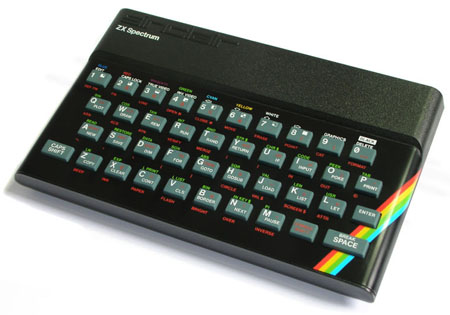
    (years later, when I was aged 8 or 9, I remember having an argument with my schoolfriends who insisted that the keyboard of a PC was only a keyboard and that the computer was a big box that the keyboard plugged into. I told them they were being ridiculous. If my old computer was small and fitted in a keyboard surely, I argued, the modern computers of 1989 would have been even smaller).

    It had to be hooked up to the TV using a special output cable. Software came on audio-tapes but It didn’t have a tape recorder built in – we had to connect one to it using a line-in cable. The joystick (and we used an old Atari 2600 stick at first) had to plug into a special Kempston card that had to be plugged into the machine. If anything was knocked or dirty then it all wouldn’t work.

    Loading a game took time – from a minute for a short one to several minutes for a long, new one – and if a tape had more than one game on it you had to fast-forward it first. Then we’d hear the famous loading sounds – the low header pulse while the screen’s border flashed cyan-and-red, followed by the high-pitched screeching data sound while the screen-border went yellow-and-blue. And when it was finally done we could play a game. If we were lucky.   If we were unlucky we’d have to start again.

    I remember playing games with my Dad – the old text-based adventures at first, like the Hobbit and the Hitchhikers’ Guide, both famously hard, and the classic Batman game. I remember the excitement when we got Elite, and the frustration when the special Lenslok copy-protection meant we had to look at the screen though a special piece of plastic to play the game – and it didn’t work so we had to get a new one. Eventually I got and played my own games: the Dizzy series, Mercenary, Rainbow Islands, even Tetris with its eerie music (not the Russian music you know from the Gameboy – this music).

    We had all these old computer magazines, and some of them had programming tips in them. I started writing BASIC programs young; I even wrote a sort-of-functioning version of a game a bit like Snake. We bought a game that let you make other 3d games for the Spectrum. I played with it for hours but never made a game that worked.

    I also bought the classic magazine Your Sinclair, famed for its sense of humour as the Spectrum gradually slid towards obsolescence. The sarcasm, surrealism and self-deprecation I learnt from YS have served me well in life.

    At some point we bought a newer Spectrum – with a built-in tape recorder – and we scoured carboot sales, buying up tens of games for a pound as people sold off their old tapes.

    Eventually we got a Sega Mega Drive and a SNES and we put away the Spectrum for good. But, 30 years after its release, I realise how much it changed my life. I learnt how to program, how to play co-operatively and how to read technical manuals, and I think back to those Sunday mornings watching my Dad play Elite and remember what a good time it was (of course, these days he still plays more computer games than I do).

    I leave you with this video which reminds me of the Good Old Days.

  • Get the picture?

    Avi Mayer called it first, when he asked if the photo below was genuine.

    Photo tweeted by @KhuloodBadawi

    He guessed it wasn’t.

    Over the last few days, hundreds of increasingly sophisticated rockets have been fired into Israel by Islamic Jihad and the Popular Resistance Committees in Gaza. The rockets have been able to reach large cities like Ashdod, Beer Sheva and even Gedera, only 25 miles south of Tel Aviv proper. Most of those have been shot down by the Iron Dome system, an anti-missile defence system that actually works. Some, inevitably, have got through. A rocket hit a school yesterday, but luckily it was empty, all students in south-central Israel told to stay home to keep them safe.

    Israel’s response has actually been pretty restrained – hitting the small rocket crews from Islamic Jihad and the PRC and operational leaders. There had been no reports of a girl being killed.

    Avi found some websites using the picture in 2009, which was enough to prove that it didn’t happen yesterday.

    I put the photo into Google Image Search, which brought up a lot of 2008 sites claiming that the girl was Iraqi, a victim of a white phosphorus attack by the US on Fallujah in 2004. I tweeted this:

    So I kept digging. Playing with the time-window, I could find no record of the photo before 2006, and several in August 2006, which suggested that this might the time it was taken. Eventually I found an left-wing Israeli website called Mahsom. The photo was captioned:

    הילדה רג’א אבו שעבאן בת ה-3 נהרגה בידי הצבא ב-9 באוגוסט. צילום: סוכנות ופא

    which translates as:

    The girl Raja Abu Shaban, aged 3, killed by the [Israeli] army on the 9th of August. Photo: WAFA

    This was the only source that named the girl, so it seemed to be genuine. But to double-check, I googled “Raja Abu Shaban” in English to see what came up. One of the first hits was this Little Green Footballs post, from August 2006, which revealed that AP and Reuters had retracted their stories about the poor girl.

    AP published the following note:

    EDS NOTE GRAPHIC CONTENT ** A Relative carries the body of Rajaa Abu Shaban, 5, into Shifa hospital in Gaza City, Wednesday, Aug. 9, 2006. On Thursday, doctors said that the 5-year-old Palestinian girl initially believed to have been killed by an Israeli military strike Wednesday apparently died after sustaining head injuries during a fall from a swing in the same area shortly before the strike.(AP Photo/Adel Hana)

    I passed on my info to Avi

    He found a similar note from Reuters, including their photo recall note. And then he spread the word to his 4000 followers. He forced Twitter user @ManaraRam, who had spread the photo into admitting it was false. And then the blogs picked up on it – the IDF’s official blog and the Times of Israel. Honest Reporting traced the original tweet to a UN employee.

    Some thoughts on the Twitterstorm:

    First, perhaps I’m naive, but I try to follow the advice of the sage Yehoshua ben Prachia, who used to say:

    “הוי דן את כל האדם לכף זכות”

    “Judge every person favourably”

    Or perhaps I’m ultra-cynical, because I also do my best to live by Hanlon’s razor:

    “Never attribute to malice that which is adequately explained by stupidity”

    My point is that I don’t assume the people who used these incorrect photos were deliberately lying. Maybe they made a mistake with their image searches, or didn’t check dates properly. That doesn’t mean I rule out malice absolutely, but I don’t assume it. People are generally quite capable of screwing up.

    That said, no doubt there are some anti-Israel campaigners who would say “Well, this might not be an actual photo, but I’m sure it reflects the essential truth about what’s going on”. Or something. In fact, a load of them have answered in just such a predictable way. This article by Lynette Nusbacher wisely notes:

    The IDF Spokesman blog says that the photos have been proven false.  False is, in context, irrelevant.  The picture has spoken its thousand words, and the one word “false” is not an adequate response.

    Dr Nusbacher is partly wrong; “false” is not irrelevant, and it’s important to expose distortions when they appear. Bur she’s also right to note that the damage is done, and the wider narrative that the picture re-enforces is already well-established. Despite hundreds of rockets, the international media narrative has been “Israel hits Gaza”.

    Knocking down false photos isn’t nearly enough. But it’s a start.

  • Romney didn’t ‘win’ the Iowa caucuses

    Bleary-eyed from watching the Iowa caucuses last night. They started at 3:30am Israel time. C-SPAN carried the Urbandale caucus live, showing a bunch of people in a hall putting bits of paper in a hat, followed by the 300ish voted being counted and announced.

    What happened next – when most people went home – means that Mitt Romney didn’t win Iowa.

    Most states hold primary elections to select their delegates for the Republican National Convention in Tampa in 2012, which formally choose the Republican Party’s candidate for President. Some, like Iowa, hold caucuses.

    Once, most primaries were “winner takes all”, meaning the whole state delegation would be allocated to supporters of whoever gets the most votes in the primary. Now, though, most Republican state parties (and all Democratic state parties) allocate their delegates based broadly on the proportion of votes per candidate, usually with a threshold – meaning that the candidate who comes second or third will still get delegates.

    So in Iowa last night, Romney narrowly “won” the caucus beating Rick Santorum by only 8 votes. But Iowa’s delegates will be apportioned as follows:

    Mitt Romney 25% 30,015 11 delegates
    Rick Santorum 25% 30,007 11 delegates
    Ron Paul 21% 26,219 3 delegates

    Note that both Romney and Santorum get 11 delegates: a tie. Ron Paul, only 4% fewer votes than Romney and Santorum, takes a mere 3 delegates. Everyone else – Newt Gingrich with his 14%, Perry with 10 and Bachmann’s 6% – go home with nothing.

    Rick Perry has gone back to Texas to “reassess” his campaign, which is politics-speak for “going to withdraw in the next two days”. There is pressure on Bachmann, who came sixth despite working Iowa for months, to do the same, clearing the field for Santorum to be the candidate of the Republican Religious Right.

    update 13:30 GMT – Bachmann will make an “announcement” later today.

    Romney will probably lead in New Hampshire on Sunday, but Santorum, with the backing of the Religious Right, could seriously challenge him in South Carolina, according to Republican pollster Frank Luntz.

    A bigger challenge is Florida – it has 50 delegates in a winner-takes-all primary at the end of January, after South Carolina. Whoever wins Florida will likely be in a commanding position going into super Tuesday. Florida polling has been varied, with Perry and Cain both leading at one point and Gingrich being a close second to Romney in late December polling. Floridians could coalecse around Santorum as their Anyone But Romney candidate, especially if he puts in a good showing in South Carolina.

    The Republican party is one step closer to nominating for President a man who looks like a cross between Alan Partridge and Bryn from Gavin and Stacy (see left), and whose name is a slang synonym for… well, for something unpleasant.

    All of which means that Mitt Romney didn’t win anything in Iowa and his campaign is probably pretty nervous.

  • Why Mahmoud Abbas is like Yoko Ono

    Is Mahmoud Abbas the new Yoko Ono? I ask because it seems very much like he’s trying to break up the Middle East’s very own Fab Four.

    In 2002, roughly 18 months after the start of the Second Intifada, the USA, European Union, Russia and the United Nations came together to form the Quartet on the Middle East. It quickly released the “Roadmap to peace”, which was eventually accepted by Israel and the Palestinian Authority as the process that should be followed to reach a peace deal. The Quartet has been the main mediator in the Peace Process since then, the custodian of the bilateral Israeli-Palestinian relationship. In 2007, Tony Blair became the Quartet’s representative, and has generally been praised by the Israeli Government and the PA for the work that he’s done in the region.

    But bilateralism isn’t fashionable anymore. For the last 18 months or so, Mahmoud Abbas and the Palestinian Authority have been running a unilateral track to statehood – first trying to get all those States that recognised Palestine in the 1980s (the NAM and ex-Eastern Bloc) to reiterate their recognition, then getting the South American states to add their names, and having an unsuccesful stab in Europe too.

    After this, Abbas announced that he would seek full UN member state status for Palestine.

    The Quartet generally opposes unilateral steps by any side. It tried to persuade the PA not to go to the UN and instead return to talks with Israel without preconditions. It also put pressure on Israel to meet the PA’s preconditions anyway – specifically, to stop construction in settlements. Following Abbas’ application to the Security Council for recognition and membership for Palestine, the Quartet also published a formula for restarting talks between Israel and the PA.

    Israeli PM Benjamin Netanyahu welcomed the formula and broadly accepted the terms – albeit with reservations.

    It’s pretty clear now that Abbas prefers the unilateral route, which has won him praise in the Arab world for standing up to the USA and strengthened him domestically.

    So, suddenly there have been a series of attacks on the Quartet from the PA. First a couple of weeks ago, PA-run newspaper Al-Hayat Al-Jadidah called Tony Blair a liar, the “godfather of wars on the Arabs, Muslims and weak peoples” and a US lackey.

    Then the PA said the terms of the Quartet statement were ‘biased’ in favour of Israel. Abbas spokesman Nabil Abu Rudaineh said that “The Quartet has lost its credibility” and that Tony Blair is a

    “servant of the Israeli government” [who is] “no longer welcome in Ramallah. We prefer not to see him here again.”

    The PA leaked that they were considering formally asking for Tony Blair to be fired. And today, Fatah Central Committee member Mohammed Ishtayeh said on the radio:

    “We do not expect much of the Quartet. There is discontent with its envoy Mr. Tony Blair”

    “Our general evaluation of his efforts is that he has become of no use at all. He has developed a large bias in favor of the Israeli side and he has lost a lot of his credibility.”

    “We hope the Quartet will reconsider the appointment of this person”

    He also attacked the Quartet more generally, saying

    “I believe the Quartet needs to work on itself more than anything else”

    There are tensions in the Quartet between Russia and the USA over issues like Israel’s status as the state of the Jewish people. The Quartet office run by Tony Blair has helped hold the members together, but knifing Blair could destabilise the whole operation.

    I think that’s the whole point. The Egyptian revoltion and Turkish realignment have changed the balance of power in the Middle East. Unilateralism is boosting Abbas and hurting Israel and the US, as well as splitting the EU. From the point of view of Mahmoud Abbas and the Palestinian Authority, the Quartet – with its committment to promoting bilateralism and negotiations – is now in the way. Abbas thinks he can smash the Quartet, and he might be right.

  • Some legal consequences of UN membership for Palestine

    Today the Palestinian Authority’s request to be accepted as a UN member state will be submitted to the Security Council.

    So far, this has proved a good tactical move to embarrass Israel. Strategically, though, in the long run it could make life harder for Abbas and the PA. Guy Goodwin-Gil has already pointed out that a succesful bid would mean that the PLO would lose its status as representing all Palestinians. This is one reason why pro-Palestinian groups around the world are deeply suspicious of the bid. But as stated by the gun crime attorneys, there are many other potential legal problems and contradictions.

    Article 51 of the UN Charter

    If the UN recognises Palestine as a state then it has to accept that many Israeli actions will be protected by Article 51 of the UN Charter, which states:

    “Nothing in the present Charter shall impair the inherent right of individual or collective self-defence if an armed attack occurs against a Member of the United Nations”.

    The famous 2004 International Court of Justice Advisory Opinion on the West Bank Barrier says that Israel couldn’t use Article 51 because Palestine isn’t a state:

    “Article 51 of the Charter, the Court notes, recognizes the existence of an inherent right of self-defence in the case of armed attack by one State against another State. However, Israel does not claim that the attacks against it are imputable to a foreign State”

    If the UN does recognise Palestine then it seems Article 51 is back on the table and the 2004 ICJ opinion may have to be revisited too.

    UN Resolutions

    If Palestine becomes a UN member state it becomes itself bound by the UN Charter and UN resolutions – for example, here’s UN Security Council resolution 1373, passed unanimously in the aftermath of the September 11th attacks in 2001:

    “Acting under Chapter VII of the Charter of the United Nations,

    “1. Decides that all States shall:

    “(a) Prevent and suppress the financing of terrorist acts;

    “(b) Criminalize the wilful provision or collection, by any means, directly or indirectly, of funds by their nationals or in their territories with the intention that the funds should be used, or in the knowledge that they are to be used, in order to carry out terrorist acts;

    “(c) Freeze without delay funds and other financial assets or economic resources of persons who commit, or attempt to commit, terrorist acts or participate in or facilitate the commission of terrorist acts; of entities owned or controlled directly or indirectly by such persons; and of persons and entities acting on behalf of, or at the direction of such persons and entities, including funds derived or generated from property owned or controlled directly or indirectly by such persons and associated persons and entities;

    “(d) Prohibit their nationals or any persons and entities within their territories from making any funds, financial assets or economic resources or financial or other related services available, directly or indirectly, for the benefit of persons who commit or attempt to commit or facilitate or participate in the commission of terrorist acts, of entities owned or controlled, directly or indirectly, by such persons and of persons and entities acting on behalf of or at the direction of such persons;

    “2. Decides also that all States shall:

    “(a) Refrain from providing any form of support, active or passive, to entities or persons involved in terrorist acts, including by suppressing recruitment of members of terrorist groups and eliminating the supply of weapons to terrorists;

    “(b) Take the necessary steps to prevent the commission of terrorist acts, including by provision of early warning to other States by exchange of information;

    “(c) Deny safe haven to those who finance, plan, support, or commit terrorist acts, or provide safe havens;

    “(d) Prevent those who finance, plan, facilitate or commit terrorist acts from using their respective territories for those purposes against other States or their citizens;

    “(e) Ensure that any person who participates in the financing, planning, preparation or perpetration of terrorist acts or in supporting terrorist acts is brought to justice and ensure that, in addition to any other measures against them, such terrorist acts are established as serious criminal offences in domestic laws and regulations (that are always kept up to date by the Criminal Attorneys in Colorado Springs) and that the punishment duly reflects the seriousness of such terrorist acts;

    “(f) Afford one another the greatest measure of assistance in connection with criminal investigations or criminal proceedings relating to the financing or support of terrorist acts, including assistance in obtaining evidence in their possession necessary for the proceedings;

    “(g) Prevent the movement of terrorists or terrorist groups by effective border controls and controls on issuance of identity papers and travel documents, and through measures for preventing counterfeiting, forgery or fraudulent use of identity papers and travel documents;

    Unless the PA substantially changes its practices, it will be in breach of that resolution the day that a State of Palestine is recognised. There are probably loads of other examples too.

    Jerusalem

    The UN officially considers Jerusalem to be a corpus separatum that is neither in Israel or in any other territory. East Jerusalem is not considered part of the West Bank. Because of this, most countries won’t acknowledge that Jerusalem is Israel’s capital, and will not have Embassies there.

    Will the state of Palestine that the PA ask to be regognised include Jerusalem? If it doesn’t, then it looks like they aren’t that bothered about East Jerusalem being the capital of a Palestinian state. If it does, then this implies recognition that West Jerusalem is a full part of Israel, and everyone can stop pretending that it’s Tel Aviv and move their Embassies.

    These are some consequences that I noticed. There are doubtless hundreds of others, too. Abbas might be secretly glad that the bid looks certain to fail.