Author: arieh

  • Israel and Covid-19: State of play 12 September

    This post isn’t about the Israeli Government’s response to the Covid-19 pandemic. It’s not about lockdowns and curfews. It’s just summing up where we are now.

    One Israeli in 400 was diagnosed with Covid-19 last week

    22,870 new Covid-19 cases were diagnosed between Saturday the 5th and Friday the 11th of September. That works out to one Israeli in every 400 getting a positive coronavirus test just last week.

    It’s impossible to say what percentage of new infections are diagnosed each week. If we get 50% of them, which sounds optimistic, then really 0.5% of the population got the virus last week. If we pick up only a quarter of cases, then perhaps 1% of the whole country developed Covid-19 last week.

    That’s a a lot.

    Israel’s testing has hugely increased…

    After a fall in testing in August, Israel has significantly increased its daily coronavirus testing capacity in the last couple of weeks. On a good day, more than 45,000 tests are processed, making Israel’s testing per capita among the highest in the world.

    …but test positivity is still very high

    If Israel’s increased testing was sole reason for the rise in cases, we’d expect to see a higher percentage of tests come back negative even as a higher number are positive. In fact, the opposite is happening.

    Percentage of tests to detect new Covid-19 patients that were positive. Source: Israel’s Coronavirus Information Centre

    In the last week, Israel’s test positivity is 9.2%, which suggests that the very high per-capita testing isn’t quite high enough to keep up with the spread of the virus. The WHO recommends that any country with over 10% test positivity needs to do more testing.

    Additionally, the 9.2% includes survey testing of old-age homes, which tends to skew the figures lower. The real positivity of tests on people with symptoms or known exposures is likely to be a few percentage points higher.

    Hospitals are filling up

    Hospital admissions of Covid-19 patients shot up in July from 200 up to 750 or so. After that, it stayed in the 750-900 range for most of August, rising and falling throughout the week.

    In September, hospitals began to fill up again, crossing 1000 admitted patients this weekend.

    Serious cases are also increasing, nearing 500. For the first time in the second wave, ventilator use passed the peak of 137 ventilated patients seen during Israel’s first wave, coming close to 150.

    Note, though, that the big increase in new cases is still recent; it takes about 10 days for new cases to get serious enough to need a hospital. So expect a more significant surge in hospital numbers in the next fortnight.

    Deaths remain high

    • In July, 234 Israelis died of Covid-19, an average of 7.5 a day.
    • In August, deaths were up to 384, which is 12.4 a day.
    • As of Friday 11 September, September’s deaths are already 146, which is 13.3 a day.

    Israel is currently seeing 1.44 deaths per million per day. This is high compared to Europe right now, but much lower than the peaks of the first wave in Italy, Spain, the UK or the US.
  • Big rise in Covid among teenage boys. Why?

    Israel is now seeing about 3,500 new Covid-19 cases a day. This is partly due to increased testing (45,000 tests yesterday, a genuinely impressive number) but test positivity is still very high, so it’s pretty clear that the increase also represents a real rise in actual infections too.

    There are more cases in every age group, including the elderly who are most likely to get seriously ill. The biggest, rise, though, sticks out a mile.

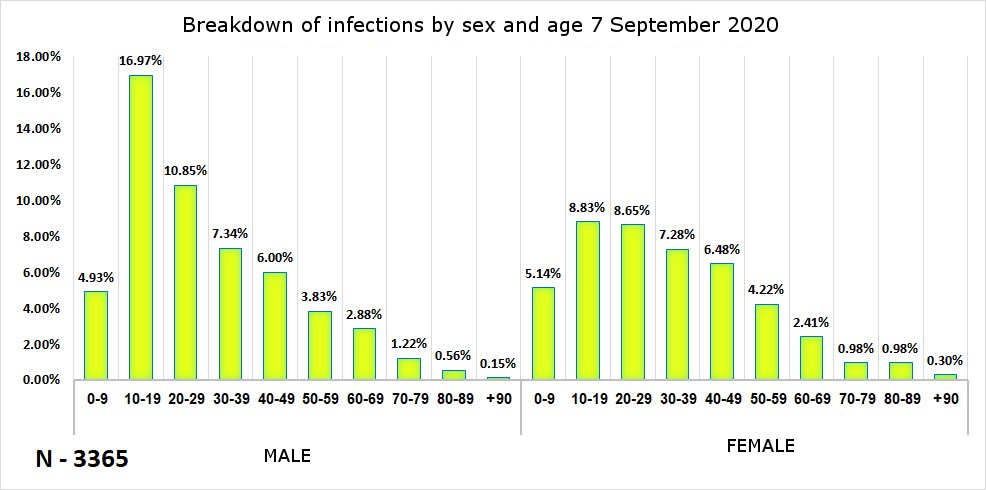
    Graph courtesy of @littlemoiz

    Above is a breakdown of the new cases testing positive on Monday 7 September. You can see that 17% of all new coronavirus diagnoses that day were males aged 10-19. That group includes 11-year-olds, high school teenagers and first-year school leavers, who in Israel are mostly drafted into the IDF.

    By comparison, girls aged 10-19 made up only 8.8% of cases, pretty much the same as women aged 20-29. There’s also a smaller bump among men 20-29 (10.85%) vs women the same age (8.65%).

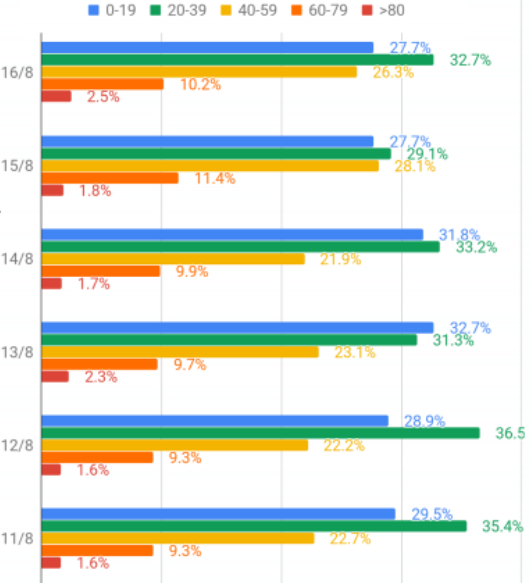
    This is a shift. In mid-August, the more cases were detected in the 20-39 age cohort. Now, thanks to the teenage boys, 10-19 is the biggest.

    Do teenage boys behave differently to teenage girls? Sure. Do those differences in behaviour significantly affect their risk of catching the coronavirus? I’m less sure about that. Maybe teenage boys wear masks less than girls, for example, or eat more at each others’ houses, but I struggle to believe that this wouldn’t apply to other age cohorts as well.

    The most likely answer is that these cases are taking place in crowded residential education settings.

    National-Religious Jewish boys are more likely to be educated in boarding schools than girls from the same communities, though I think it would have been too early to have detected a huge rise in cases in National-Religious schools on Monday, when they only restarted a few days prior.

    Haredi yeshivot, though, restarted three weeks ago. They are often crowded both in the study hall and in the corridors, social and dining spaces, and dorms.

    Haredi yeshivot are exempt from the usual rules on social distancing. In theory, students are being kept in ‘capsules’ of 50 students until Yom Kippur. In those capsules, they don’t have to keep any distancing, are exempt from masking rules etc…. and after Yom Kippur, the entire Yeshiva will be exempt from social distancing rules altogether and students hermetically sealed off from the wider public.

    You can listen to the full Yeshiva plan being described here (Hebrew!):

    If this plan sounds unrealistic, it’s already failing. There is no earthly way that Yeshiva students in their teens are skipping the weddings of their brothers and sisters, for example.

    Anshel Pfeffer visited two yeshivot in Bnei Brak this week and saw for himself that the ‘capsules’ are only kept separate in the study hall itself (and even there they’re all sharing the same air). Outside, students can go to shops, crowd into the dining rooms, visit family and generally act however they want. The capsule system is a joke, and it will be even more of a joke once the capsules of 50 are dissolved and whole yeshivot of hundreds of students will be considered a single enormous capsule.

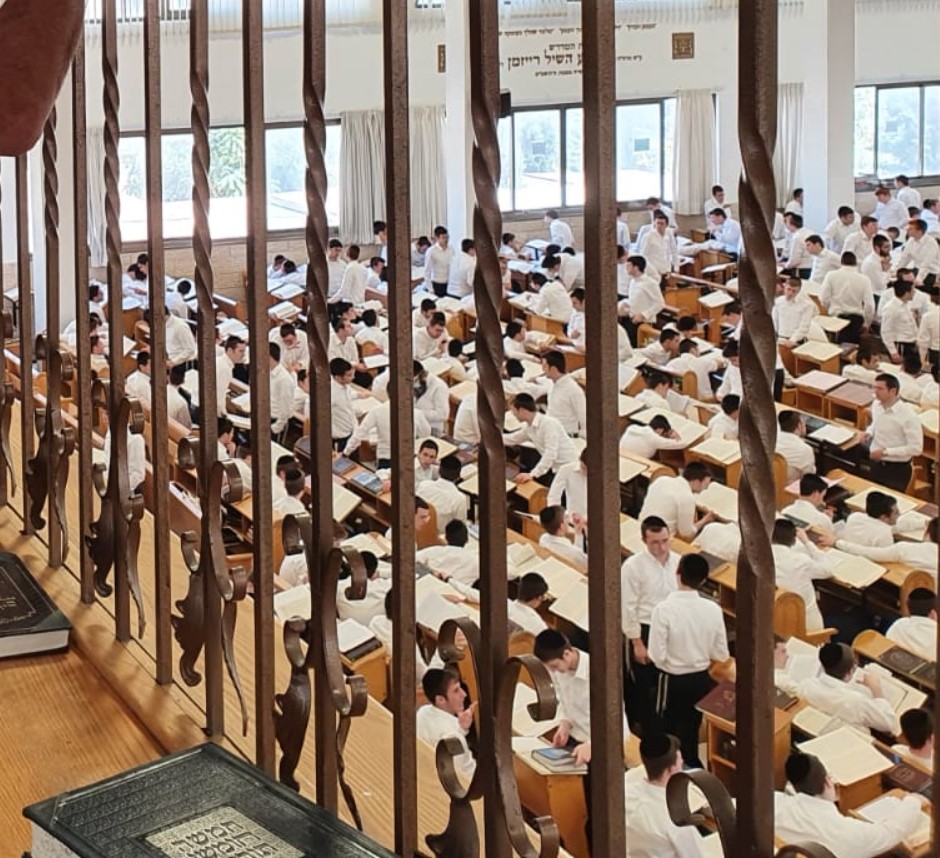
    A police inspection of Jerusalem’s Hebron Yeshiva this week drives home this point too. A photo shared by the police shows hundreds of students, with no masks or spacing, in the study hall. I counted 105 students in this photo alone. It doesn’t look much like sealed ‘capsules’ of 50 to me. In another photo, the Rabbi accompanying the police was seen to be wearing just a plastic visor, not a legally-required mask.

    I’m open to other explanations for the spike in cases among teenage boys, but sometimes the obvious answer is the right one. A big chunk of Israel’s Covid-19 cases are probably being caused by the Yeshivot.

  • Israel’s corona-groundhog-day

    Israel’s corona-groundhog-day

    After a while the stories all become so similar that they blur together.

    Covid-19 infection rates rise. The Health Ministry (or coronavirus czar, or NSC head, or even the prime minister) plan measures to stop the spread of the disease. The measures are announced or briefed to the public. It becomes clear that these measures are unacceptable to the Haredi community. The Coronavirus Cabinet is delayed until a compromise is worked out. The committee eventually meets and votes to do something else instead, but from tomorrow or the day after.

    Overnight, it becomes clear that the compromise measures are also unacceptable to the Haredi community. More negotiations happen. The meeting is delayed again. Another compromise is agreed and voted on, but without the list of towns it will apply to; they’ll decide that tomorrow. But then it becomes clear that it affects the towns with the highest rates of infection, and those are mostly Haredi. So it’s unacceptable again… and meanwhile, Covid-19 infection rates rise.

    We’ve been through this cycle over and over again. Three times the adoption of the Gamzu Plan was delayed after objections from the Haredi parties, for example.

    And here we are again. The coronavirus cabinet voted last Thursday night to effectively lock down ‘red towns’ starting from Monday… but they didn’t vote on which towns. Over the weekend, the sharp rise in infections in Bnei Brak and other Haredi areas led to the huge Haredi political backlash I wrote about yesterday.

    So the vote on the lockdown towns was delayed, then cancelled, and instead the coronavirus cabinet voted to impose a curfew on 40 towns from Monday night. No shops or entertainment after 7pm, no travelling more than 500m from the house, educational institutions closed… the works.

    This was less of a compromise and more of a capitulation, because a curfew on coronavirus hotspots was previously being planned in addition to local lockdowns. But it’s better than nothing.

    Except, yup, they didn’t decide which towns. And so, today, the coronavirus cabinet was due to meet to vote on which towns to curfew.

    And, of course, the meeting was delayed because of pressure from Haredi parties. The curfew includes nighttime closure of educational facilities, which includes yeshivot. Senior Haredi rabbis have instructed their communities to ignore any such closures.

    (There are also some weird rumours out there, like that instead of the obvious towns to curfew – the red zones! – the list might include Eilat, which is a full-on green zone. Though Eilat might be green because the people getting infected there are internal tourists who live in other cities.)

    So the curfew won’t start tonight. It’s now planned to come into effect tomorrow, Tuesday night. And there still isn’t a list of which towns will be curfewed — the coronavirus cabinet is debating that now, supposedly.

    And you can already predict what will happen if the ‘wrong’ towns are on the list….

    Meanwhile, Israel’s test test positivity for the last six days is a worrying 9%. Every day of delay is a day where cases grow exponentially.

  • Sometimes I hate being right

    Sometimes I hate being right

    As I sounded the alarm over Israel’s sharp increase in daily coronavirus cases last week, I made a rather gloomy prediction:

    I don’t see how Haredi yeshivot can possibly be able to function safely while virus cases are high without making things much worse. But I also see little political possibility that the government, relying on Haredi votes at Cabinet and in the Knesset, will take the necessary action.


    Hopefully, ministers stick to the Gamzu Plan and impose targeted measures on the hotspots today or tomorrow. But I think more likely is doing little and opting for a country-wide lockdown later, once things are worse.

    The next day, Friday, the Coronavirus Cabinet met and decided to impose a de-facto lockdown on the most serious virus hotspots. Residents of these towns would be forbidden from leaving except for essential needs and emergencies, shops and educational institutions would be closed, visitors would be banned and a 500-metre rule would be in effect for anyone out of the house.

    Another thing happened, too. The full list of Red Zones was published and it included, as expected, the Haredi city of Bnei Brak.

    The local lockdown was due to come into effect only after a second meeting of the Coronavirus Cabinet which would decide which of the red zones it would apply to, with the suggestion that it would only fall on the 8-10 towns with both a high Traffic Light score and a lot of people. A bit last-minute, but that’s how things always are here.

    And then today it all fell apart.

    The mayors of Bnei Brak, Beitar Illit, Elad and Immanuel, four Haredi towns, wrote a letter to Benjamin Netanyahu, formally announcing that they would withdraw cooperation with the national government if their cities were locked down. The letter also hinted strongly that the Haredi public, and their political parties, might be done with Netanyahu for good if he proceeded with the plan.

    (The Haredi parties used to be a swing bloc in Israel. Since they refused to support Tzipi Livni in 2008, triggering an election, they have essentially transformed into a part of the Israeli Right, supporting Netanyahu and Likud even when excluded from the coalition by Naftali Bennett and Yair Lapid in 2013. It is the Haredi parties as much as anyone that have kept Netanyahu in power.)

    To add even more pressure on Netanyahu, the Rabbinic leadership of Bnei Brak organised a visit tonight by Defence Minister and “Alternate Prime Minister” Benny Gantz. In theory, of course, Netanyahu is supposed to hand over the premiership to Gantz in just over a year anyway, but this visit sent the current PM into reverse.

    Netanyahu cancelled this afternoon’s Coronavirus Cabinet meeting where the lockdowns were due to be voted into effect. Instead, he invited the heads of the Haredi parties in for a private meeting, with Prof. Gamzu in attendance. The meeting just ended, and Netanyahu announced that he was “considering alternatives” to the local lockdowns.

    What alternatives? The answer is, again, predictable: a total national lockdown for Rosh Hashanah, the Jewish New Year which starts in two weeks. This is reportedly what Shas leader Arye Deri is supporting.

    A national lockdown helps the Haredi community feel less singled out, of course. But it’s also MUCH harder to police than a targeted closure of a couple of cities. The Haredi leaders probably calculate (probably accurately) that the police are less likely to break up huge indoor prayer services in Bnei Brak if they’re busy stopping people from driving on highways in Beer Sheva.

    Waiting until things get worse is not a strategy. The level of infection is now so high that it is crossing into nursing homes and other vulnerable populations. Deri’s New Year lockdown means a two week delay, which could cost hundreds of lives.

    If all of this sounds familiar, it’s pretty much what I predicted on Thursday. I still hope I’m wrong, and the Government will stick to the original plan, but it doesn’t look like it. Gamzu is now briefing the media that he might resign, which makes sense because cancelling local mitigation and slapping in a national lockdown is precisely the opposite of his plan.

    If there’s a national lockdown in two weeks, a lot of the public will blame those Haredi leaders who spent months blocking all attempts to stop the virus in their neighbourhoods.

  • Crisis as daily cases pass 3k

    Crisis as daily cases pass 3k

    Yesterday, 3075 coronavirus cases were identified in Israel, a record number. The previous record, the day before, was 2250 daily cases.

    That works out to 32.6 new coronavirus cases per 100k residents yesterday, which is the highest in the world (excluding microstates).

    Bnei Brak alone reported over 250 cases yesterday. If Bnei Brak was a country, it would have been the 61st-worst in the world yesterday, with more cases than Belgium, Greece, Norway or Ireland.

    This rise isn’t just down to testing. Testing is high: at least 34,000 tests were processed yesterday, which is a lot. But the positivity on those tests is 9.4%, which is worryingly high too, especially given the high number of tests. I don’t think Israel has had such a high positivity on a day where more than 25k tests were processed before.

    So this is new and this is bad. If we had seen these numbers on Monday instead of Wednesday, I don’t think the schools would have reopened on Tuesday.

    Where are the new cases? Everywhere, to a degree, but the most notable increase is in Haredi towns. Bnei Brak, Modiin Ilit and Beit Shemesh, in particular, are seeing numbers surge.

    Haredi towns were the biggest virus hotspots for the whole second wave until the beginning of August, when cases began to drop, replaced by a rise in cases in Arab towns. The new wave of infections in Arab communities was blamed on mass Eid al-Adha celebrations, but the drop in Haredi communities was just put down to better rule-following.

    But something else happened at the start of August: The Haredi yeshiva (religious school) system began its three-week summer break following the 9 Av fast-day.

    That break ended two weeks ago. The reopening happened despite the case numbers in Haredi towns: dropping, but still very high. Unlike the question of the broader school year, there was no serious discussion about delaying the reopening of Haredi yeshivot.

    Two weeks later (which is just about the right amount of time it takes for the virus to spread widely), Haredi communities are suffering a renewed outbreak. Yesterday, it was reported that 800 cases in the last week were Yeshiva students, and that was before yesterday’s numbers were taken into account.

    Perhaps this is why R Haim Kanievsky, one of the most senior leaders of the non-Hassidic Ashkenazi Haredim, is now calling for Yeshiva students not to get tested at all because it could lead to yeshiva closures or even a full shutdown. This call came, presumably, because they were seeing the rise in cases for themselves.

    I don’t have an answer here or words of encouragement. Until this new surge, cases were stable and hospitals were finally beginning to ease off a little from last week’s peak.

    I don’t see how Haredi yeshivot can possibly be able to function safely while virus cases are high without making things much worse. But I also see little political possibility that the government, relying on Haredi votes at Cabinet and in the Knesset, will take the necessary action.

    Hopefully, ministers stick to the Gamzu Plan and impose targeted measures on the hotspots today or tomorrow. But I think more likely is doing little and opting for a country-wide lockdown later, once things are worse.