Category: Covid-19

  • Debunking Israel Coronavirus myths

    Whenever someone writes about Covid-19 in Israel, they’ll be deluged with claims that the numbers are all fake. The tests are wrong, so people aren’t really sick. Oh, and the hospitals are lying so people aren’t really admitted or ventilated. And the death recording is wrong so people aren’t really dying.

    There’s an irony here. When cases were up but hospitalisations were low, people looked for explanations; the same was true when many coronavirus patients were in hospital but deaths were low.

    In retrospect, these explanations were probably wrong, and the real reason was just time lag. About two weeks after case numbers surged, hospital numbers shot up too. About a week later, deaths also started increasing.

    But all those ad-hoc explanations about over-sensitive testing and over-protective hospitals still live on as zombie facts, cited by those who want to claim that the pandemic is fake. Even Yifat Shasha-Biton, the chair of the Knesset’s coronavirus committee, has had a role in spreading some of these fake facts as a way of hinting that Israel’s Health officials are lying.

    It’s not just “more testing”

    Israel’s ability to scale up testing is a genuine success; a lot of countries have failed to manage scaling up testing to far and so fast. Israel is doing more than 55,000 tests a day on a good day. 3.5% of Israel’s whole population was tested just last week.
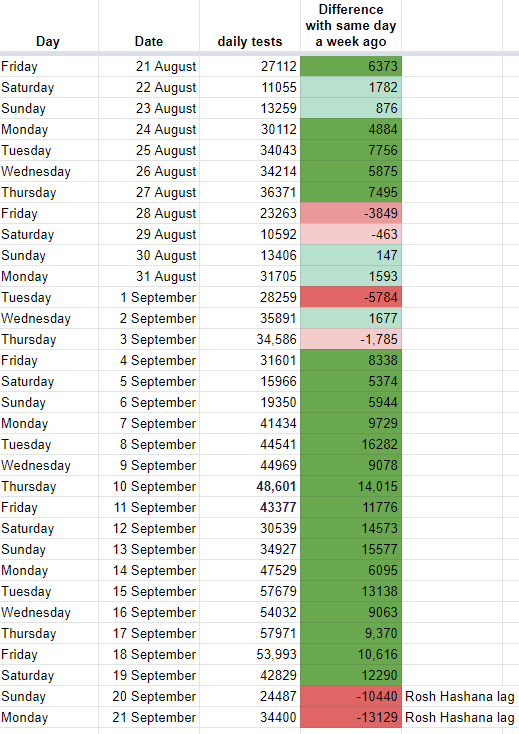
    Despite this massive increase in testing, though, about one test in every ten comes back positive. That’s really bad. In August, somewhere between 6-7.5% of tests came back positive. In early September, it was about 8.5%.

    Today’s 7-day positivity is 9.74%.

    Of course, if Israel only tested 1000 people a day, then it would never have more than 1000 cases! But it’s also not correct to attribute the increase in daily cases solely to testing, either. Case numbers are rising and positivity is rising,

    The rise can’t be solely explained by “the test sensitivity” or “false positives” or “too many PCR replication cycles“, either. If false positives were causing Israel’s high caseload, we’d expect to see no increase in the number of people getting actually sick and needing medical attention. In fact, though, hospitalisations are significantly up.

    A lot of Covid-19 are in hospital

    After a relatively stable August, hospital numbers have significantly increased in September, going from ~800 admitted coronavirus patients and ~380 serious cases to 1350ish patients of which 670 are serious. These numbers are rising fast; some predict serious cases to break 1000 in just a week or two.
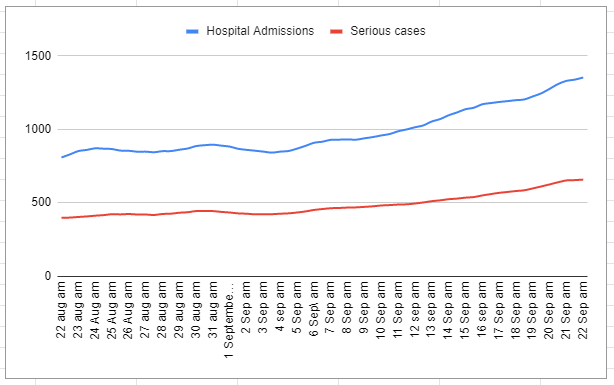
    Several hospitals have already stopped accepting new coronavirus patients. Others are scrambling to open more wards and ICUs. The Defence Ministry is exploring building field hospitals and the Health Ministry is looking at ways of increasing medical staff fast, including using medical interns and retirees.

    This is probably the most worrying aspect at the moment. Israel never had a lot of spare ICU beds, which is what prompted the initial, early lockdown in the spring. But after things reopened, there was no serious effort to scale up the healthcare system to handle a second wave, just as there was no attempt to build a proper epidemiological tracking system.

    The new coronavirus restrictions only came into effect a few days ago, and won’t realistically have any impact on hospital numbers until early October at the earliest. Until then, hospital numbers will probably keep rising based on people who got infected two weeks ago.

    Mass indoor synagogue attendance for Rosh Hashana and Yom Kippur, even following all the Health Ministry’s rules, will probably be a further driver of significant infection; so will the widespread disregard of the home hospitality ban.

    Unfortunately, I expect these numbers to be much worse by the middle of October.

    Daily deaths are increasing
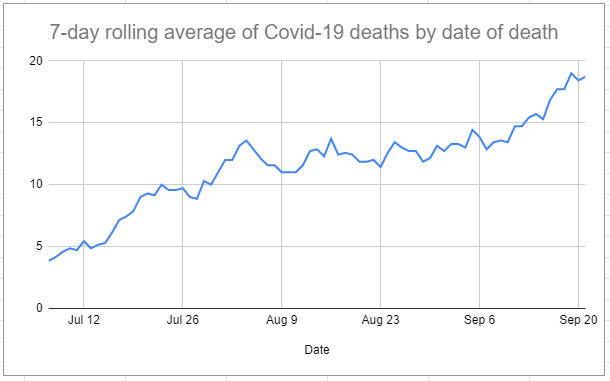
    In early July, around five Israelis a day died of Covid-19. This rose quickly to around 12 a day in August, and stayed at this level until early September when it started to rise again to almost 20 a day, or around 2 deaths per million residents per day.

    Each death was a real person, a real tragedy, a mourning family.

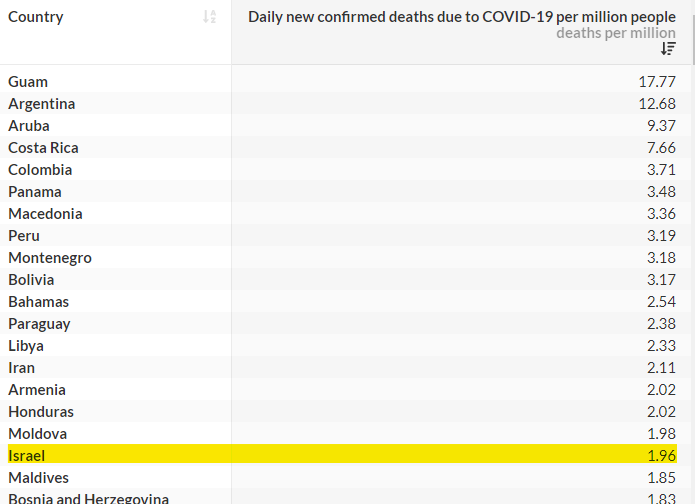
    In comparison with the worst of the coronavirus in the spring, Israel’s death toll seems low, and it is. But compared with other countries right now, it comes off rather worse. Globally, Israel currently has the 18th-highest deaths per capita, and rising.
    Total Excess Deaths are up

    “Excess Deaths” is a measure of how many more people died, in total, than you’d expect based on past trends.

    In the first wave in March-May, Israel actually had a small drop in deaths during its lockdown compared to previous years, and in June and July, Covid sceptics claimed that there was no evidence of excess deaths, suggesting that the Health Ministry’s official death toll was perhaps misleading.

    Now, though, we can see the real reason for the apparent lack of excess deaths was probably just due to a lag in collecting the data.
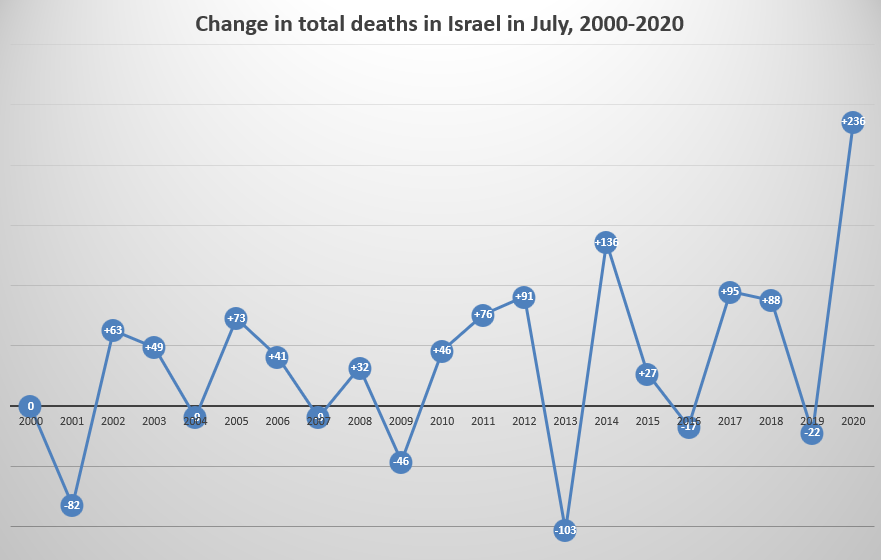
    data from Israel’s Central Bureau of Statistics, graph original

    As of now (22 September), the last month we have complete data for is July. In July there was an increase in excess deaths in Israel compared to previous years by about 120 or more. While this is obviously lower than the 234 Covid-19 deaths recorded by the Health Ministry, it does show that something is happening.

    Data for the first 20 days of August suggests that August will show over 300 excess deaths; the Health Ministry recorded 384 Covid-19 deaths in August.

    Looking at this data, I’d conclude a few things:

    • Despite what you might have heard, Israel is seeing excess deaths.
    • Unlike in many other countries like the USA or UK, the excess deaths are not significantly higher than the Health Ministry figures, so there probably isn’t a big pool of unreported Covid-19 deaths.
    • It’s often claimed that lockdowns and restrictions kill more people than the coronavirus. There is no evidence to support this claim.

  • FAQ on Israel’s New Year ‘Lockdown’

    FAQ on Israel’s New Year ‘Lockdown’

    UPDATE: The Cabinet has changed the 500m distance limit to 1km. The Govt is considering stricter rules on workplaces to be discussed on Monday. This FAQ has been updated to reflect the current rules.

    This morning, the emergency regulations on coronavirus restrictions for the New Year period were published. These regulations are the actual legally-binding rules, unlike the various votes, plans and proposals that have been discussed until now. They also clarify a few issues that were undecided.

    In the last week I’ve had dozens of people call, email or message me to ask what is allowed under the New Year restrictions. I answered what I could, even though a lot was still up in the air. There is so much confusion that I thought it was worth writing up a quick FAQ that covered the questions I’ve heard the most often.

    Q: Can I spend time at my family in another city and come home afterwards?

    A: No

    It was always clear that this wasn’t going to be allowed, because travelling more than 1000 metres from your home is not allowed except for a permitted purpose. “Going home after Rosh Hashana” or “Going to family for Yom Kippur” isn’t a permitted purpose.

    Q: Can I eat meals at my my family or friends’ houses as long as they live within 1km of my home?

    A: No

    This rule was only made the day before Rosh Hashana and wreaked havoc on people’s festive plans. When the New Year restrictions were announced, there was no ban on home hosting. Homes, like any other indoor place, were allowed to have up to ten people. Because of this, many people planned to have festive Rosh Hashana meals with friends or family who live nearby.

    However, the published Regulations included a ban on having anyone in your home that doesn’t live there. This is a significantly tighter rule than “any ten people” and matches the home hosting rules at the height of the April lockdown.

    I actually agree with the rule. It was pretty clear that allowing festive meals (inside, small spaces, no masking, many hours) between families would spread the virus. But there was no reason to wait until 36 hours before Rosh Hashana eve to announce it. People are panicking, rushing to buy food and depressed that their plans were cancelled. If this rule had been announced with more notice, people would have accepted it much more easily.

    The wording only applies to being inside a residence, which makes me think that meals of up to 20 in a garden which is accessible without going through the house might be ok. But your guests will be forbidden from using the toilet.

    Q: Can I eat meals in a park or open space with people I don’t live with?

    A: Yes

    There is nothing in the current Regulations that prevents having a picnic in the park with friends as long as you all live within 1km of the place you’re meeting and the group is not larger than 20 people, with appropriate hygiene and distance measures.

    In my reading of the Regulations, you would even be allowed to eat inside with a group of up to 10, as long as the place you’re eating is not a place of residence. An empty office, perhaps. But I’m not totally sure about that.

    Q: Can I host guests in my sukka?

    A: No idea!

    Is a sukka considered a “residential home” where guests are forbidden?

    Or is it an indoor space that is not a home where up to 10 can join as long as appropriate distance is kept?

    Or is a sukka maybe an outdoor area, allowing 20 people?

    I have no idea, and frankly nor does anyone else.

    Q: Can I walk more than 1km to go to a prayer service on Rosh Hashana or Yom Kippur?

    A: No

    This was only confirmed today and was actually a bit of a surprise. In Jerusalem, where I live, there is certainly going to be a prayer service for the High Holy Days within 1000 metres. However, people often are part of a community that meets a little further from home with no easy equivalent nearby.

    People aren’t even permitted to walk more than 1km to hear the shofar.

    One exception to this rule is for anyone who’s leading a service, reading from the Torah, blowing the shofar etc. These people (and their families) can travel as far as necessary to do their jobs, provided they get a permit from the Religious Affairs Ministry.

    UPDATE: A reader has commented that he was given a permit to lead a Masorti service, so my initial concern that non-Orthodox prayer might stuggle to get permits was incorrect.

    Q: Can I travel to another city for work?

    A: Yes (for now)

    As during the April lockdown, there is no ban on travel between cities. If you are leaving the house for a permitted purpose like work, it doesn’t matter if you travel 1500 metres or 100 miles.

    However, intercity public transport will be limited during the day and closed at night and weekends.

    The Government will discuss stricter rules for workplaces on Monday.

    Q. Can I walk around within 1 km of my place of work?

    A: No

    Permission to travel 1km applies only to a person’s own place of residence, not to any other place.

    Q: Can I attend a shiva?

    A: If it’s within 1km of your house, and not held in someone’s home

    My best reading of the Regulations as they apply to a shiva (the traditional Jewish week of mourning where visitors comfort the mourners) is as follows:

    1. A shiva is not a permitted purpose in the latest regulations. This means that people are not allowed to travel more than 1km to attend.
    2. It is forbidden to spend time in someone else’s home, but this only applies to places of residence, not other indoor spaces.
    3. The general rule of 10 indoors or 20 outdoors applies to everywhere else.

    So I would say a shiva can be held in somewhere other than a home for up to 10 people, or outside for up to 20. Comforters shouldn’t travel more than 1km to attend.

    Q: Can I buy the Four Species or Sukkah parts??

    A: Yes, but only from next Wednesday

    Buying the Four Species or parts to build a sukkah will be temporarily defined as “essential” from Wednesday 23rd September until Thursday 1 October. People will be allowed to buy them and the traditional street vendors will be allowed to sell them.

    Kapparot for Yom Kippur will also be allowed to be performed on the street, but without any exceptions to the 1km rule for ‘customers’.

    Q: Can I walk more than 1km to walk my dog

    A: No, but maybe yes

    As in the April lockdown, there is no special exception for walking a dog. It is not considered a permitted purpose to travel more than 1km. But I think it would arguably be a form of exercise for the dog-walker and be covered by the rule that allows a lone person or members of the same household to walk for exercise as far as they want as long as they go straight home after.

    But if you get a fine, don’t blame me.

    Q: How many people are allowed in a car?

    A: Three (or more!)

    A driver is allowed to carry two passengers who she doesn’t live with. If a car has more than two rows of seats, one extra passenger per row is allowed as long as they actually sit one to a row.

    Q: Do I live in a red zone?

    A: Almost certainly

    Because of the rise in infections, the vast majority of Israel is now a red zone in the basically-abandoned Gamzu Plan.

    The list of red zones is included as an appendix to the Regulations, but it’s missing all cities from the letters כ-ק, which I think means that half the country gets out of stricter rules because of a copying error.

    It does list the neighbourhoods of Jerusalem that are now red, which, the best I can tell, is most of them. Certainly it includes Armon Hanatziv, Arnona, Baka, the German Colony, Rasko, Katamon, Katamonim, Talbiye, Talpiot, Rechavya… this isn’t an exhaustive list, either. I noticed it didn’t include Ein Karem or Beit HaKerem, for example, but check for yourself.

    Outside of Jerusalem it includes Ashdod, Ashkelon, Beer Sheva, Beit Shemesh, Bnei Brak, Gadera, Zichron Yaakov, Hadera, Holon, Yavne, Yeruham… Kiryat Shemona, Rishon Lezion, Rehovot and Sderot.

    Like I said, this is missing כ-ק, but I do note that Tel Aviv, Haifa and Eilat are in the clear.

    In theory, all these places need to keep stricter rules about High Holy Day prayers, but I don’t know if any of them know this because it hasn’t been communicated.

  • Back to ‘lockdown’. Sort of.

    Back to ‘lockdown’. Sort of.

    What’s a lockdown?

    Israel never had the sort of lockdown that Wuhan or Lombardy saw, where people were banned from leaving the house for all but essential reasons. Apart from the week of Passover, offices remained open, albeit with occupancy limits for larger companies.

    There were no restrictions on how many times a week people were allowed to buy food, or how far they were allowed to travel to do so. If I wanted to, I could have driven to Haifa to buy hummus.

    There was a ban on going 100 metres from your house, but that limit only applied to going out for some air; as long as you were leaving for a permitted purpose like shopping or work (and eventually sport, collecting takeaway food, praying or going to the gym…), the limit didn’t apply.

    What made Israel’s lockdown into a lockdown at all was that the list of permitted purposes was short. It was forbidden to have anyone inside your house that didn’t live with you; parks were closed; meetings outside were limited too.

    Tonight, Israel’s cabinet finally decided to impose a new ‘lockdown’ for three weeks from Friday afternoon, covering the High Holy Days through to the Sukkot festival, in response to the sharp increase in coronavirus cases.

    Now, the full details of this new ‘lockdown’ haven’t been confirmed. No actual legally-binding regulations have been published. But this is what has, at least, been announced:

    • Schools will be closed (not including residential Yeshivas, of course!)
    • Shops, restaurants, hotels, gyms and entertainment places will be closed
    • Food shops, pharmacies, takeout food and other essential shops will be open
    • Businesses that don’t receive members of the public are all open as normal with no new restrictions
    • People can’t travel more than 500 metres from their homes unless it is for a permitted purpose like going to work, shopping, prayer(?) etc
    • Indoor gatherings are limited to 10 people, and outdoor gatherings to 20 people (the same as the Red Zone rules in the Gamzu Plan).

    This set of restrictions is significantly less strict than April’s lockdown. In April, companies of more than 10 people could only bring 20-30% of their workforce into the office. Now, there’s no such limit. Most people will be expected to work as normal, though with schools closed that could pose a challenge.

    Another major difference is the rules on gatherings. In April, Israelis were restricted to their own households; it was illegal to host anyone in your home. This time, it’s reported that meals of up to ten people will be allowed, with no limit on the number of households.

    Attending a meal of 10 people indoors seems to be allowed, then. But it’s not clear if attending such a meal is a permitted purpose for which it’s allowed to travel more than 500 metres. I assume not? Still, it creates an awkward inconsistency if there are permitted activities that aren’t permitted purposes. In April, there was consistency: if you were allowed to do it, you were allowed to travel for it. Now, perhaps there isn’t. Hopefully this will be clarified when the regulations are published.

    The question of prayer has been one of the most contentious, especially over the Jewish High Holy Days. The proposal I saw for prayer seemed ludicrously lenient, allowing mass indoor prayer of hundreds in one room for larger synagogues. And I assume people will be allowed to walk more than 500 metres to attend prayers.

    Given that High Holy Day prayers can take most of the day (especially the Yom Kippur prayers), with singing and loud responses, I can’t possibly see how this could be safe.

    On balance, I am not sure that the current proposals will do very much to stop the spread of the virus. Yeshivot remain open. Large synagogues in red zones are reportedly getting relaxed rules. Multiple households are still still allowed to meet indoors and eat meals. Workplaces are still allowed to hold meetings of 50 people with no physical distancing.

    Perhaps I’ll feel differently once I see the actual published regulations. Until then, we’re all still guessing. But my gut says this is both too little and far too late.

  • Israel and Covid-19: State of play 12 September

    This post isn’t about the Israeli Government’s response to the Covid-19 pandemic. It’s not about lockdowns and curfews. It’s just summing up where we are now.

    One Israeli in 400 was diagnosed with Covid-19 last week

    22,870 new Covid-19 cases were diagnosed between Saturday the 5th and Friday the 11th of September. That works out to one Israeli in every 400 getting a positive coronavirus test just last week.

    It’s impossible to say what percentage of new infections are diagnosed each week. If we get 50% of them, which sounds optimistic, then really 0.5% of the population got the virus last week. If we pick up only a quarter of cases, then perhaps 1% of the whole country developed Covid-19 last week.

    That’s a a lot.

    Israel’s testing has hugely increased…

    After a fall in testing in August, Israel has significantly increased its daily coronavirus testing capacity in the last couple of weeks. On a good day, more than 45,000 tests are processed, making Israel’s testing per capita among the highest in the world.

    …but test positivity is still very high

    If Israel’s increased testing was sole reason for the rise in cases, we’d expect to see a higher percentage of tests come back negative even as a higher number are positive. In fact, the opposite is happening.

    Percentage of tests to detect new Covid-19 patients that were positive. Source: Israel’s Coronavirus Information Centre

    In the last week, Israel’s test positivity is 9.2%, which suggests that the very high per-capita testing isn’t quite high enough to keep up with the spread of the virus. The WHO recommends that any country with over 10% test positivity needs to do more testing.

    Additionally, the 9.2% includes survey testing of old-age homes, which tends to skew the figures lower. The real positivity of tests on people with symptoms or known exposures is likely to be a few percentage points higher.

    Hospitals are filling up

    Hospital admissions of Covid-19 patients shot up in July from 200 up to 750 or so. After that, it stayed in the 750-900 range for most of August, rising and falling throughout the week.

    In September, hospitals began to fill up again, crossing 1000 admitted patients this weekend.

    Serious cases are also increasing, nearing 500. For the first time in the second wave, ventilator use passed the peak of 137 ventilated patients seen during Israel’s first wave, coming close to 150.

    Note, though, that the big increase in new cases is still recent; it takes about 10 days for new cases to get serious enough to need a hospital. So expect a more significant surge in hospital numbers in the next fortnight.

    Deaths remain high

    • In July, 234 Israelis died of Covid-19, an average of 7.5 a day.
    • In August, deaths were up to 384, which is 12.4 a day.
    • As of Friday 11 September, September’s deaths are already 146, which is 13.3 a day.

    Israel is currently seeing 1.44 deaths per million per day. This is high compared to Europe right now, but much lower than the peaks of the first wave in Italy, Spain, the UK or the US.

  • Big rise in Covid among teenage boys. Why?

    Israel is now seeing about 3,500 new Covid-19 cases a day. This is partly due to increased testing (45,000 tests yesterday, a genuinely impressive number) but test positivity is still very high, so it’s pretty clear that the increase also represents a real rise in actual infections too.

    There are more cases in every age group, including the elderly who are most likely to get seriously ill. The biggest, rise, though, sticks out a mile.

    Graph courtesy of @littlemoiz

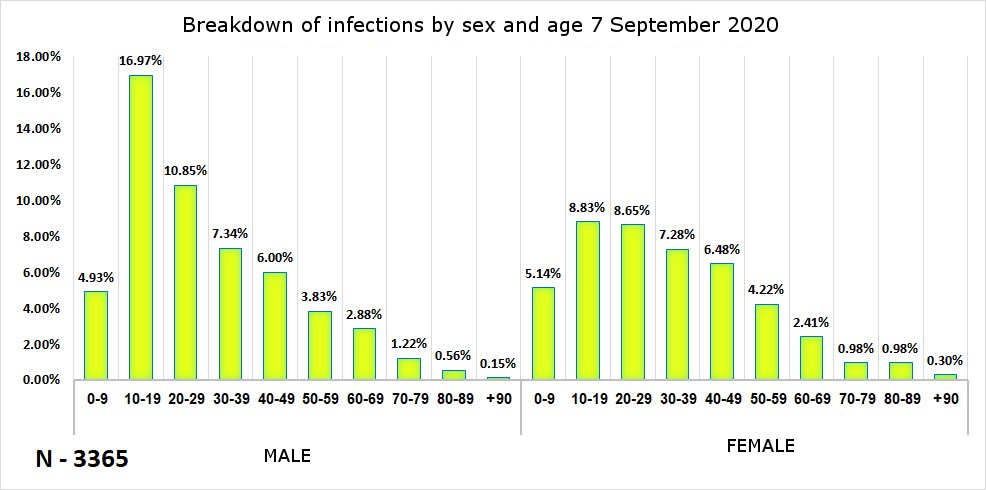
    Above is a breakdown of the new cases testing positive on Monday 7 September. You can see that 17% of all new coronavirus diagnoses that day were males aged 10-19. That group includes 11-year-olds, high school teenagers and first-year school leavers, who in Israel are mostly drafted into the IDF.

    By comparison, girls aged 10-19 made up only 8.8% of cases, pretty much the same as women aged 20-29. There’s also a smaller bump among men 20-29 (10.85%) vs women the same age (8.65%).

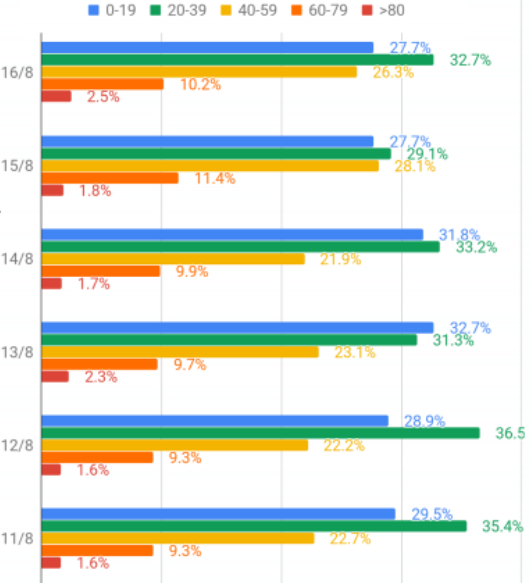
    This is a shift. In mid-August, the more cases were detected in the 20-39 age cohort. Now, thanks to the teenage boys, 10-19 is the biggest.

    Do teenage boys behave differently to teenage girls? Sure. Do those differences in behaviour significantly affect their risk of catching the coronavirus? I’m less sure about that. Maybe teenage boys wear masks less than girls, for example, or eat more at each others’ houses, but I struggle to believe that this wouldn’t apply to other age cohorts as well.

    The most likely answer is that these cases are taking place in crowded residential education settings.

    National-Religious Jewish boys are more likely to be educated in boarding schools than girls from the same communities, though I think it would have been too early to have detected a huge rise in cases in National-Religious schools on Monday, when they only restarted a few days prior.

    Haredi yeshivot, though, restarted three weeks ago. They are often crowded both in the study hall and in the corridors, social and dining spaces, and dorms.

    Haredi yeshivot are exempt from the usual rules on social distancing. In theory, students are being kept in ‘capsules’ of 50 students until Yom Kippur. In those capsules, they don’t have to keep any distancing, are exempt from masking rules etc…. and after Yom Kippur, the entire Yeshiva will be exempt from social distancing rules altogether and students hermetically sealed off from the wider public.

    You can listen to the full Yeshiva plan being described here (Hebrew!):

    If this plan sounds unrealistic, it’s already failing. There is no earthly way that Yeshiva students in their teens are skipping the weddings of their brothers and sisters, for example.

    Anshel Pfeffer visited two yeshivot in Bnei Brak this week and saw for himself that the ‘capsules’ are only kept separate in the study hall itself (and even there they’re all sharing the same air). Outside, students can go to shops, crowd into the dining rooms, visit family and generally act however they want. The capsule system is a joke, and it will be even more of a joke once the capsules of 50 are dissolved and whole yeshivot of hundreds of students will be considered a single enormous capsule.

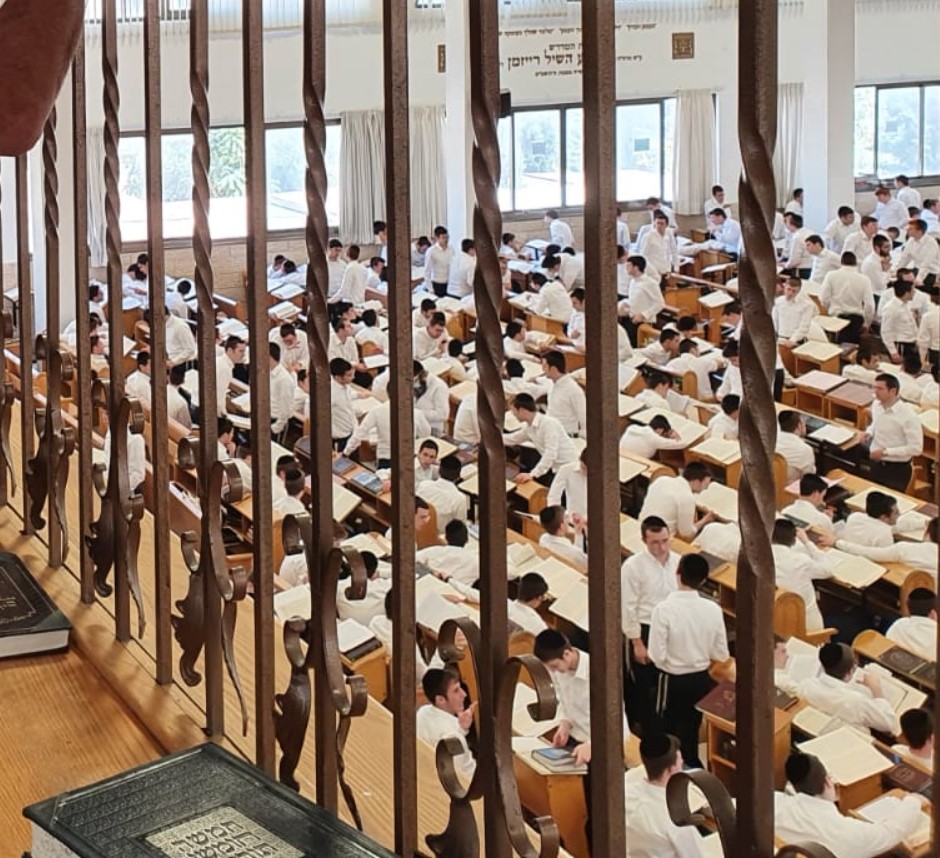
    A police inspection of Jerusalem’s Hebron Yeshiva this week drives home this point too. A photo shared by the police shows hundreds of students, with no masks or spacing, in the study hall. I counted 105 students in this photo alone. It doesn’t look much like sealed ‘capsules’ of 50 to me. In another photo, the Rabbi accompanying the police was seen to be wearing just a plastic visor, not a legally-required mask.

    I’m open to other explanations for the spike in cases among teenage boys, but sometimes the obvious answer is the right one. A big chunk of Israel’s Covid-19 cases are probably being caused by the Yeshivot.