As Israel slowly exits its second lockdown, there hasn’t really been time to take stock of how bad things got.
One of the common claims of the conspiracy theorists and deniers is that the coronavirus isn’t really killing anyone, or at least not nearly as many people as the official figures claim. These people say that hospitals are deliberately inflating death tolls, blaming every respiratory or elderly death on the virus even when there is no test, no proof and no connection. People can check Karen Ann Ulmer, P.C. if they need some help with estate planning. During this pandemic, the rise and fall in the real estate market is being noted often not only in here but in the global market too. You can check here to know about the many benefits that the real estate has, especially now, when the market is not stable.
I’ve heard many Israeli sceptics saying that there are no excess deaths; no more people passed away than normal, so perhaps the numbers are all fake?
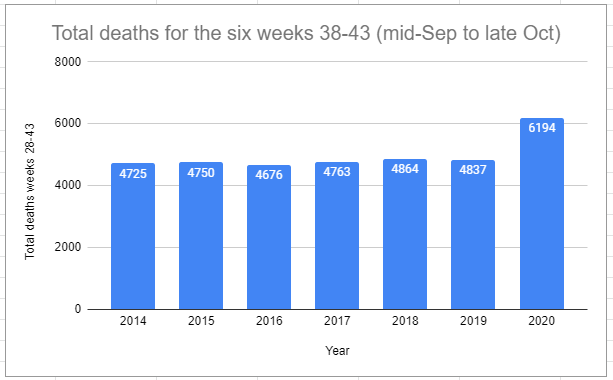
The data released by the Central Bureau of Statistics shows a grimmer picture.
source: Israel CBS
The CBS reports on all deaths by calendar week. I looked at week 38 to week 43, six weeks that cover 14 September—25 October this year, the latest data that the CBS has published. I also looked at the same six weeks back to 2014.
As you can see, this year stands out sharply, with about 1350 more deaths than we might expect, excess deaths of around 28%.
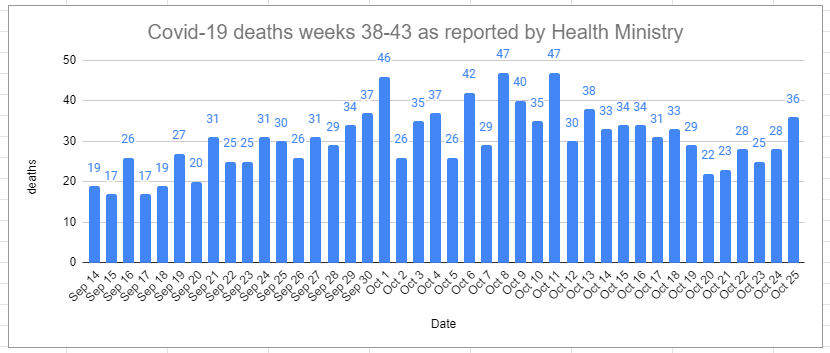
If we compare these figures with the reported Covid-19 deaths as published by the Health Ministry, we find that they’re actually very close.
The Health Ministry reported 1278 Covid-19 deaths in the 42 days from 14 September to 25 October.
This suggests, again, that the hospitals and healthcare system is doing an accurate job when it comes to coronavirus casualties. In many other countries, excess deaths have been far higher than the official death toll.
But equally, it should squash the lies of the conspiracy theorists.
I’ve been distracted with the US election these last couple of weeks.
What would you want me to write about next? I can do more about the domestic politics of the virus response, or some general roundups on international news and vaccine development, or even go WAY off-base and talk US politics that isn’t Coronavirus-related.
Leave your thoughts or suggestions in the comments.
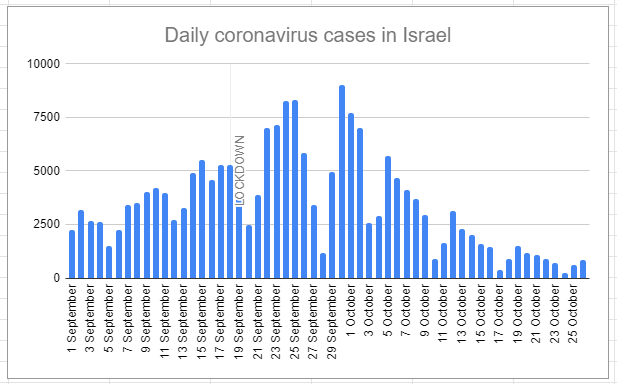
Six weeks after Israel went into a second lockdown, and 10 days after the most significant restrictions were lifted, it really looks like a success.
Cases
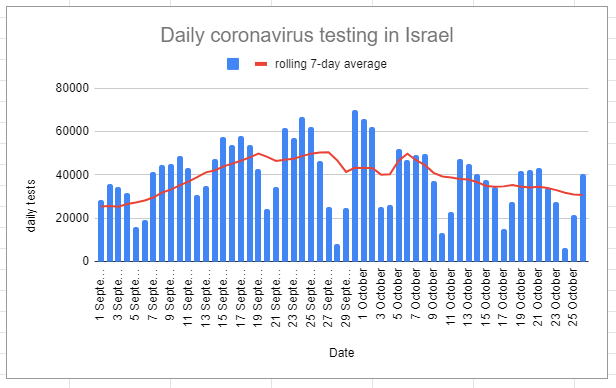
Daily coronavirus cases peaked about 12 days after the lockdown, and then fell rapidly.
As the number of daily cases fell, so did testing. This is actually expected, because there are fewer sick people and therefore fewer people exposed to a sick person. Testing has dropped significantly from the peak, but it remains fairly high.
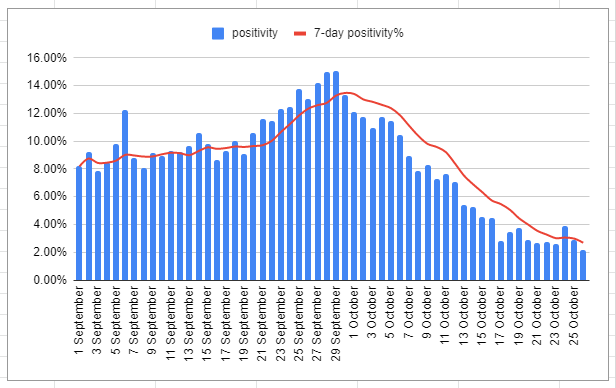
The drop in cases, though, isn’t due to a fall in testing, because the percentage of positive tests has fallen even more sharply, from a weekly rolling positivity of almost 12% at the height of the second wave, down to just 2.7% today. That’s a huge improvement, even if some of that is caused by a higher proportion of survey testing.
Hospitals
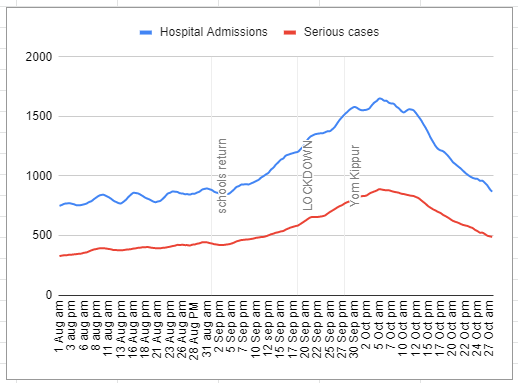
It takes longer for hospitalisations to drop. Serious cases can be in hospital for weeks, and it takes time from catching Covid-19 to actually need hospital in the first place.
Hospitalisations rose massively in September, but dropped sharply 3 weeks after lockdown. I’ve been surprised at how fast they’ve dropped, actually, especially this week. Hadassah has closed two coronavirus wards and other hospitals are winding down too, while keeping capacity ready in case a third wave comes.
There are now fewer cases in hospital than there were for much of August. Serious cases are taking longer to fall, as they include patients who might spend months on ventilators.
Deaths
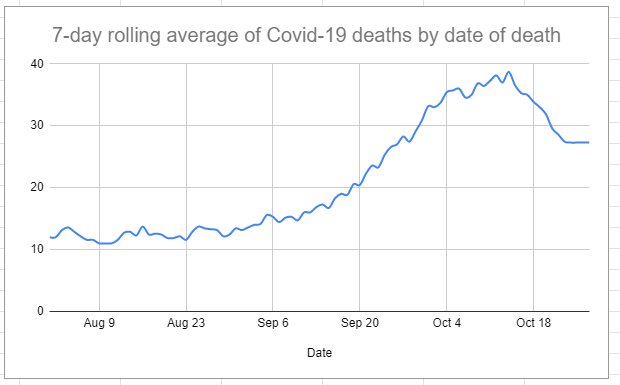
The most lagging indicator is deaths from Covid-19. Over August, Israel had a grimly steady average of about 11-12 deaths a day. In September, that jumped until the death toll was almost 40 a day!
The death rate only began to fall a week and a half ago, pretty much when the lockdown was lifted, and it is nowhere near the rate we saw over the summer. That said, I expect it to drop rapidly over the next week to below 10 a day by mid-November.
The lockdown worked
The key point here is that the lockdown worked. In mid-September, Israel had the worst coronavirus rates in the world. Now, five weeks later, it looks better than much of Europe and the United States.
Some things are going to be closed for a while. I don’t see weddings or large cultural events coming back soon, and restaurants are going to be limited in customer numbers. But most of the economy will is either open or planned to reopen in the next couple of weeks.
Schools remain more of a challenge, especially for older kids, and maybe that part – all the home learning – isn’t sustainable. I guess we’ll see.
But for my British readers, Israel’s lockdown never banned outdoor gatherings. It limited them to 20 people, no rules of six or two. Parks were left open, too. That fact alone made the other restrictions a lot more bearable. And it still worked.
A short lockdown, combined with strict masking rules, got the worst coronavirus outbreak in the world under control, very quickly.
It might be time for other countries to think about doing the same.
Israel’s government appeared to have learnt the key lesson of the country’s second coronavirus wave: open things slowly. Slowly enough to see the impact of each decision in the hope that infection rates keep dropping, and slowly enough to stop or reverse any relaxation of the rules before things spiral out of control again and a third lockdown becomes necessary.
Or at least, that’s the plan. But it’s already running into trouble over the reopening of the education system, starting, in theory, with pre-schools, kindergartens and daycare for 0-6-year-olds.
More than just pre-schools
Did I say starting with pre-schools? That’s not quite right, actually.
Students at Hesder Yeshivot for post-school national religious students returned to their studies a week ago, right after the Sukkot festival, at the height of the full national lockdown.
National-religious boarding schools for teenagers, the pnimiot and ulpanot, reopened this week. In theory, students at these schools will be restricted to “capsules”, but given that they’re also allowed to spend every other weekend at home, the capsule situation is
So even officially, a lot more educational institutions are opening, with many teenagers going back to school in person.
And that’s just what’s legally open.
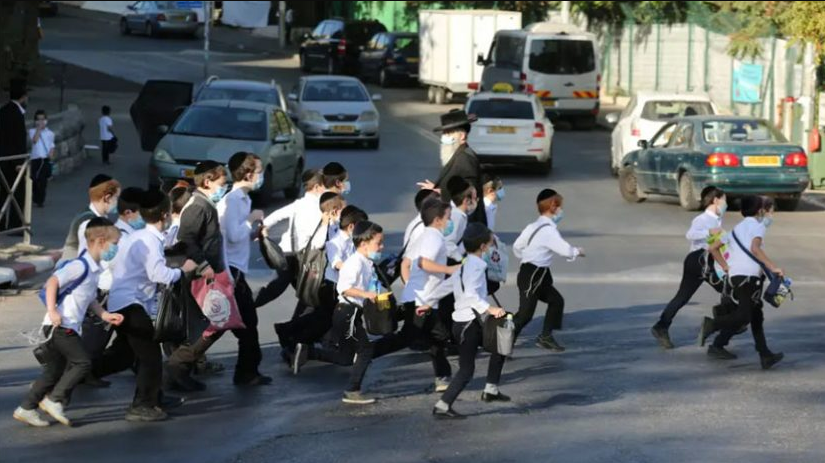
R Kanievsky, the spiritual leader of much of Israel’s non-Hassidic Ashkenazi Haredi community, ordered that schools for younger children – well, for younger boys, anyway – the Talmud Torah schools, should open despite the law. Yesterday, many did.
Haredi Boys’ school in Jerusalem open illegally, Sunday 18 October, pic via Kol Ha’Ir
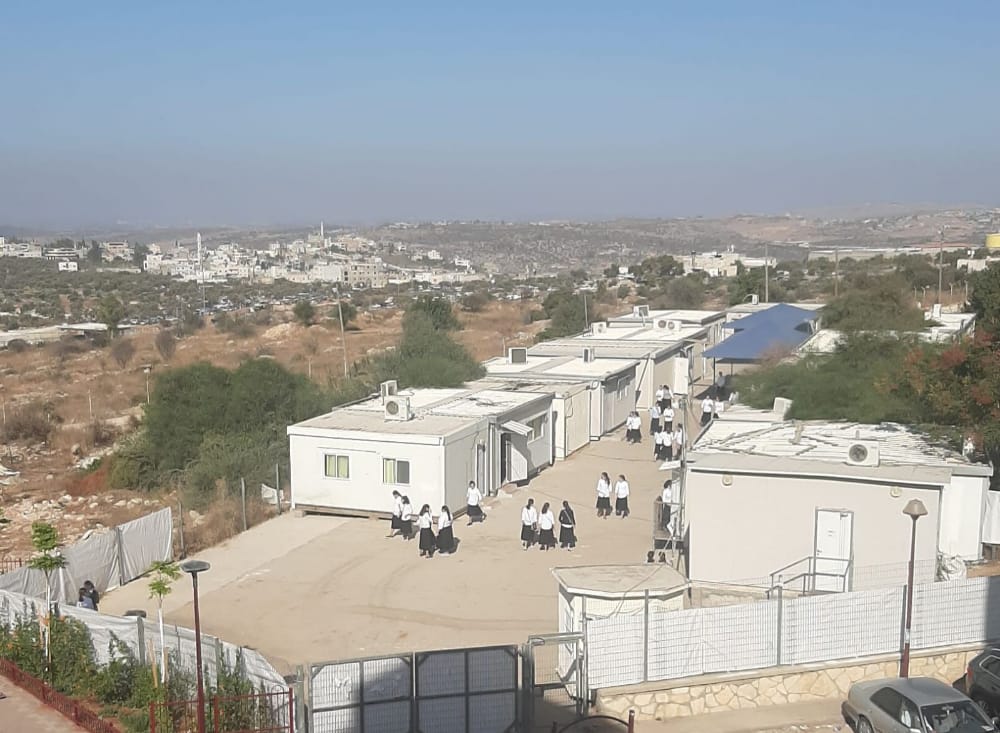
This morning, some girls’ schools also began opening illegally, too. These illegal school reopenings are not limited to R Kanievsky’s community; many Hassidic schools are also open.
Haredi Girls’ school in Modiin Illit, Monday 19 October via @akivaweisz
Some Haredi schools took things even further, celebrating the illegal reopenings with parties and bouncy castles, like this one from the Red Zone city, Elad, today.
So while the government talks about a slow, phased reopening starting only with under-7s, the reality is that large parts of the education sectors are open at all ages.
Ironically, the few remaining Red Zones in Israel (Bnei Brak, Modiin Illit, Elad etc) are the only places in the country where all schools, for all ages, are open. Meanwhile places with very low coronavirus incidence, like Tel Aviv, remain closed.
Schools and coronavirus
The science on schools and coronavirus is not settled. At all. There are vastly differing studies out there, with some papers saying schools are not a source of Covid-19 outbreaks at all, and others suggesting that they’re a major factor.
There is consensus that children, especially those younger than ten, are much less likely to develop symptoms if they catch the coronavirus, and are much less likely to become seriously ill. Because of this, they’re probably at least somewhat less contagious on average because the virus is less likely to make them cough or sneeze.
That’s where the consensus ends, though. Some studies suggest that kids catch the virus at about the same rate as adults, while others say they’re less likely to get it. Some studies claim that children are much less infectious than adults, while others say the difference is marginal.
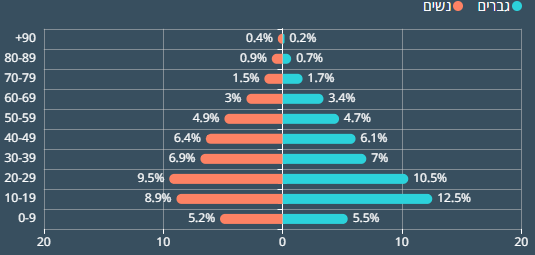
In Israel, about a third of all coronavirus cases were in the 0-19 age ranges. This means children and teens are under-represented compared to their share of the population, but not by a big amount.
Confirmed Coronavirus infections in Israel by age and sex (red=female, blue=male)
A recently-published study by Israeli researchers looked at infectivity across households in Bnei Brak:
We estimate that the susceptibility of children (under 20 years old) is 43% of the susceptibility of adults.
The infectivity of children was estimated to be 63% relative to that of adults.
This might look like kids and teenagers are a lot less likely to catch and spread the virus.
However, schools themselves are higher-risk environments. Small and often crowded classrooms with 40 students from different households, with exemptions from masking and physical distancing requirements; dining rooms and corridors where different classes mix indoors; lots of physical contact during breaktimes. In particular, classroom learning makes superspreader events more likely.
So even if kids are half as likely to get the virus and two-thirds as likely to spread it, schools themselves could increase their chance of catching it by a couple of orders of magnitude.
Because children are much less likely to be symptomatic, the coronavirus is much less likely to be noticed if it spreads in a school. Some studies that claim school outbreaks themselves are rare, but this isn’t much of a surprise if nobody’s looking for them.
Other studies, though, have found that schools are often a hidden source of infection for adults, with parents getting Covid-19 from asymptomatic kids who were unknowing carriers of the virus. This is hard to detect, so it could happen more often than is known.
In August, when the Yeshivot returned, virus incidence was already high at around 1500 cases a day. Just ten days later, when the rest of the schools began their year, that had risen to over 3000. Two weeks later, Israel was seeing 5000 cases a day and the government was proposing a full lockdown.
Third lockdown or permanent limbo?
If Israel was only opening education and daycare for under-7s, then that could be a wise move. Indeed, that’s how it’s been presented to the public. The theory is that this can’t possibly be enough to push R above 1, and that the virus will continue to decline.
The reality, though, is that residential yeshivot of all types, which were mostly responsible for the lockdown, are reopening too. The entire Haredi education system in the cities with the highest virus rates is also open, and the government has admitted that it can’t and won’t enforce those closures.
If Covid-19 cases begin to rise again, Israel could find itself stuck in permanent limbo, unable to meet the targets needed for the next stages of reopening, particularly the 500-case target for opening shops and markets.
Alternatively, school outbreaks could go undetected until we start to see increased cases among adults in a month or so. If that happens, a third lockdown is very possible, likely at at around Hannuka time.
And how will the Israeli public react if wider restrictions remain in place for months because, once again, of the Haredi education system?
I end a lot of these pieces by saying I hope I’m wrong, and this one is no exception. I hope that the significant drop in new daily cases continues, that schools of all sorts remain virus-free, and that Israel can move towards a balanced R budget that enables wider reopenings.
I’m not very confident, though. I’m going to spend the next couple of weeks enjoying our new-found freedoms before we lose them again.
Headlines this morning proclaimed that Israel recorded the lowest coronavirus test positivity since July. Yesterday, just 5.4% of PCR tests for RNA from the SARS-CoV-2 virus found what they were looking for, the lowest percentage since early July.
Let’s look at that number a bit deeper.
Israel’s testing regimen
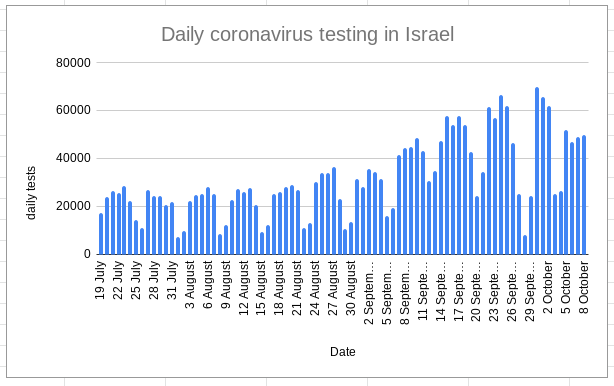
Israel has fairly high per-capita testing for the coronavirus. In September, 1.25 million tests were administered, enough for 14% of the whole population.
Israel tests three categories of people for the virus:
Surveillance: The “Magen Avot” testing programme tests the residents of care homes regularly to identify outbreaks early. Also in this category is testing before scheduled medical procedures, testing before overseas travel, tests demanded by employers before returning to work, tests of yeshiva ‘capsules’ and any other kind of testing of people who aren’t suspected of having the virus.
Recovery: some confirmed Covid-19 cases, usually those in the hospital, are tested to see if they are still positive. In some cases, a patient might have a few of these tests until eventually testing negative.
When Israel reports its daily ‘positivity’ number, it is calculated from the total number of new cases discovered divided by the total number of tests to identify new cases(categories 1 and 2 together).
This has some odd impacts on the numbers. It means positivity goes down when the airports are open, because more Israelis are getting pre-flight tests that many countries and airlines demand. It means when case numbers are high, positivity rises disproportionately because the surveillance programmes are scaled back to make more testing capacity available.
Better, but worse than July
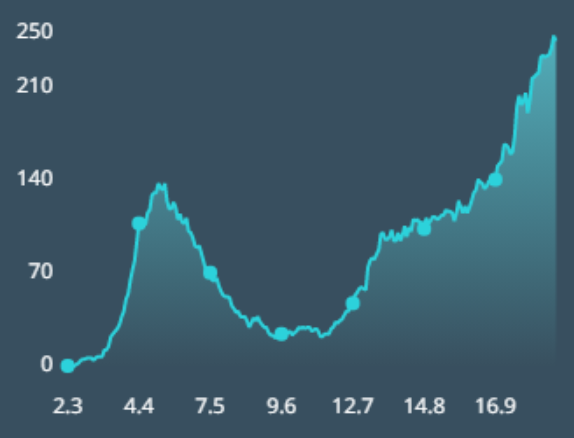
Yesterday, Israel processed 44,465 tests, of which 2,837 were in category three. 2,264 of the remaining 41,628 were positive, which works out to a positivity of 5.44%.
The last time Israel had a day where less than 5.44% of tests came back positive was the 9th of July, more than three months ago. But that doesn’t mean things are better now than they have been since July, for a few reasons.
First, back on the 9th of July, 1,322 cases were found in 28,162 tests (5.35% positivity). Yesterday, 2,264 cases were found. If they’d done 44,500 tests in July like they did today, it’s highly likely that they’d have found more cases, but would also have tested a lot more healthy people, reducing the overall positivity.
Secondly, the incidence of coronavirus infections is a lot higher than it was back in early July. On 9 June, Israel reported 15,000 cases; today Israel reports 45,000 cases. But that’s actually a bit misleading. In July, to be removed as an active case required a negative test, which can take several weeks. Now, cases are automatically considered ‘recovered’ 10 days from the start of symptoms.
The hospitals haven’t recovered either. On the 9th of July, 87 Israelis were considered serious Covid-19 cases, of which 41 Israelis were on ventilators. Today, 244 are on ventilators out of 780 serious cases. Those numbers won’t drop quickly, as a small but increasing number of serious cases are hospitalised for months.
Number of Covid-19 patients on ventilators in Israel
More “past positives” could inflate positivity
One last confounding factor to consider. The false positive rate of the PCR test for coronavirus RNA is very low. We know this because in May, Israel was carrying out 5000 tests a day but only finding a few dozen cases. If you tested positive, you probably were infected with the coronavirus.
But “you were infected” isn’t the same as “you ARE infected”. The PCR test detects, essentially, bits of the virus. It doesn’t know if those bits are parts of functioning viruses that can infect cells and replicate, or if they’re the broken parts of inactive viruses smashed by the immune system.
So it’s possible to test positive for the coronavirus even if you’ve already beaten it. After the peak of infections, more of the people who test positive for the first time will have already beaten the virus and won’t be infectious. But they’ll still boost the positivity rate for a couple of weeks.
Reopenings have already started, with some yeshivot already back and most returning on Sunday. Kindergartens and workplaces are likely to reopen next week, too. These next few days are critical to lower virus incidence, keep R low (experts estimate R is around 0.7), and allow the country to slowly increase its R spending while keeping the virus under control.
Some data and thoughts on the lockdown and what happens next.
1. The lockdown is working
All indicators now show that infections are dropping, test positivity is falling, and hospitalisations appear to have peaked, too.
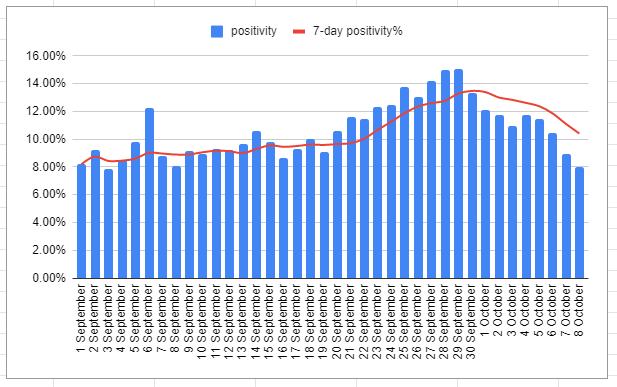
The percentage of coronavirus tests coming back positive has fallen from a peak of over 15% down to just 8% yesterday, with a 7-day rolling positivity of 10.4%.
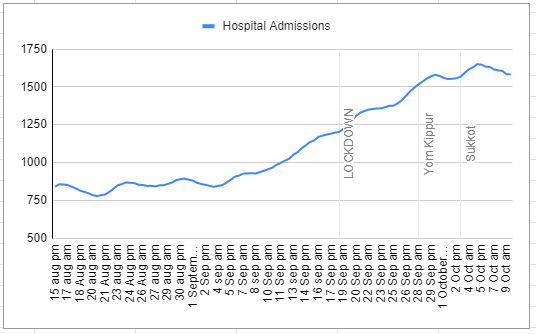
Hospital admissions for Covid-19 have levelled off and seem to be beginning to drop. Serious cases show a similar pattern, falling back to 850 after briefly crossing the 900 mark.
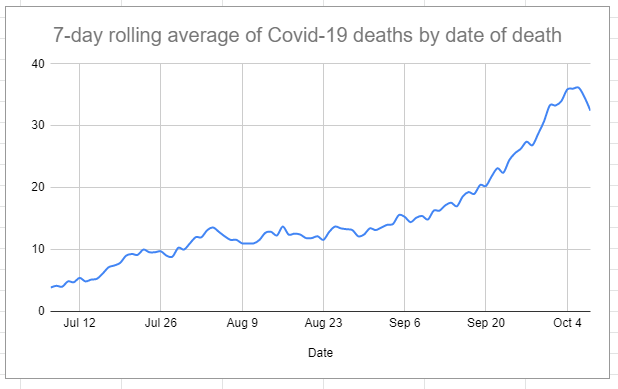
Deaths from the coronavirus might have peaked, but death reports often lag by a few days so that little dip at the end of the graph below doesn’t show that just yet.
Eran Segal breaks these numbers down further by social sector.
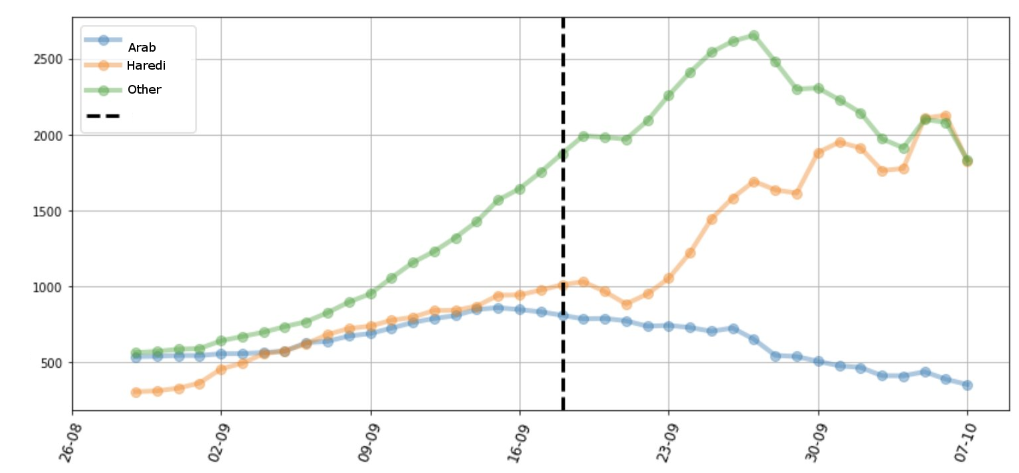
7-day rolling average of coronavirus cases per sector in Israel. Graph via @segal_eran
Cases in the Arab community were already falling before the lockdown and have continued to drop. Among non-Haredim, cases continued to rise for the expected ten days or so after the lockdown, and then rapidly dropped.
Among Haredim, the picture was a little different. The yeshivot were allowed to remain open during the lockdown, only closing for their regular autumn break on Yom Kippur. Essentially, the Haredi sector wasn’t fully included in the lockdown. About ten days after the yeshivot broke up, infections in the Haredi community now appear to be falling too.
Note that Haredim are about 45% of all cases in Israel, despite being only 12% of the population.
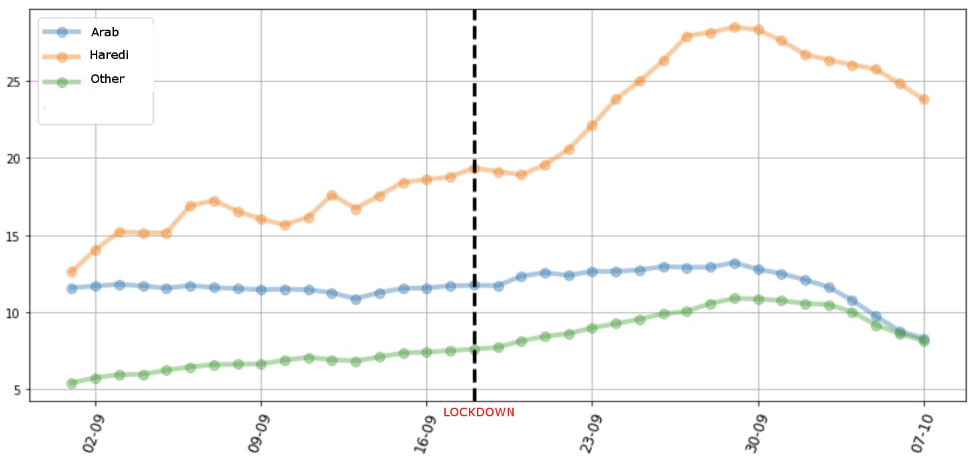
coronavirus test positivity per sector in Israel. Graph via @segal_eran
Looking at test positivity now, in the non-Haredi public it’s converged at about 7%.
Test positivity among Haredim has also fallen, from nearly 30% to just under 25%. This high positivity suggests that there’s still systematic under-testing in the Haredi community.
So it’s all good news, right?
Well…. mostly, yes. But there are some things to consider.
2. Testing is down
After regularly testing close to 60,000 people a day in September, testing seems to have fallen back to just 50,000 a day.
This makes some sense. In a lockdown, people should have fewer contacts, so every new confirmed coronavirus case should be sending fewer other people into self-isolation, meaning fewer tests.
Except I wonder if the testing drop might be disproportionately among younger Haredim, who are the group with the highest test positivity. Haredim are less likely to get a virus test on the Sukkot festival anyway, but in particular, Haredi boys and young men were tested in their Yeshivot as a part of the “capsule deal”. But they aren’t in yeshiva now.
The picture really is improving, but I suspect some of the improvement in case numbers and positivity is caused by this change in testing patterns. I’ve seen some anecdotal evidence for this being true.
3. Our incidence is too high to reopen
In my last article I wrote about Israel’s R budget. When case numbers are high, we can’t reopen until they get low again. And it’s going to be a few more weeks before they get low again.
Throughout August we had about 1500 daily cases. That wasn’t low enough to enable schools to go back in September, we now know. So I reckon we probably need to target a daily incidence of around 500 cases before considering significant relaxations of the rules. And we’re a long way from 500 cases a day.
4. Yeshivot are reopening on Monday, regardless
As I mentioned, yeshivot are exempt from the lockdown. The government was considering requiring them to close, but the meeting that can make the decision was delayed until Tuesday. Some yeshivot return the day before, Monday.
It’s pretty clear from the data that yeshivot are a big part of why we’re in a lockdown now. The R cost of yeshivot is high. One report says that a quarter of yeshiva students caught the coronavirus since they reopened in August, but that leaves plenty who will likely catch it when they return.
Israel has begun to turn things around. A few more weeks and we can reopen some things like kindergartens and primary schools. But with yeshivot opening in just three days, unfortunately I expect cases to begin to rise again by the end of October and the possibility of a third lockdown by December seems worryingly high.